
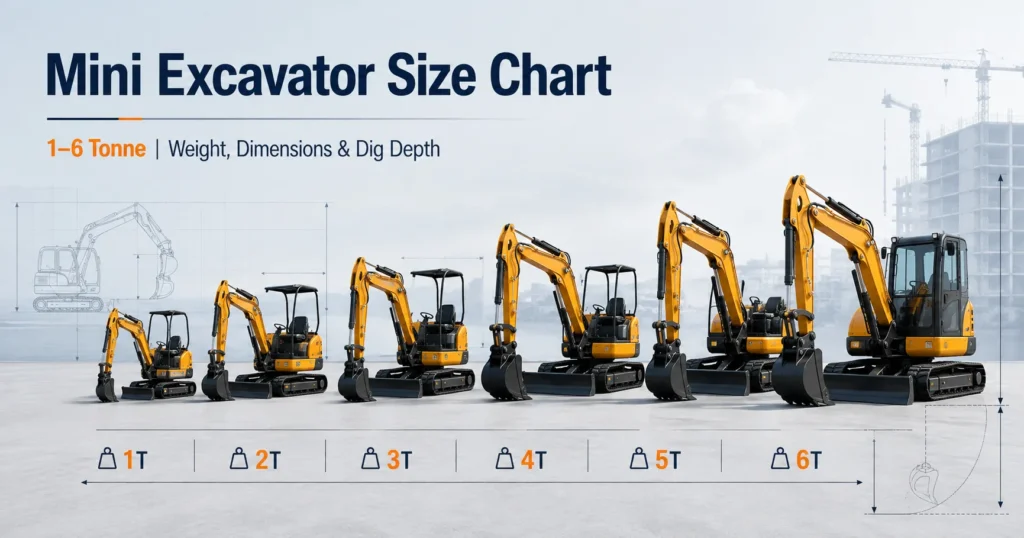
Buyers usually start with a tonne number. “I need a 2 ton mini excavator.” It is a reasonable place to start, but the tonne figure is a weight class, not a specification — and on its own it tells you almost nothing about whether the machine will get onto your site, fit through your gate, or reach the bottom of your trench.
We build and export mini excavators from 1 tonne to 6 tonnes, so the numbers below are taken directly from our own machines’ specification sheets rather than assembled from other people’s catalogues. Use the chart to narrow down a class, then check the two figures that actually decide most jobs: overall width and maximum digging depth.
Mini excavator size chart
| Model | Operating weight | Overall L × W × H (mm) | Max. digging depth | Engine | Rated power |
|---|---|---|---|---|---|
| RF-10 | 1,000 kg | See note 1 | 1,200 mm | Koop / Briggs & Stratton | 13.5 kW |
| RF-12 | 1,200 kg | 2,870 × 1,000 × 2,285 | 1,700 mm | RATO | 7.6 kW (12 HP) |
| RF-15 | 1,500 kg | 2,775 × 1,000 × 2,200 | 1,800 mm | Briggs & Stratton / Kubota | 10 kW |
| RF-18 | 1,800 kg | 3,250 × 1,100 × 2,300 | 2,200 mm | Kubota / Yanmar | 10.2 kW (15 HP) |
| RF-20 | 2,000 kg | 3,250 × 1,100 × 2,300 | 2,200 mm | Kubota / Yanmar | 10.2 kW (15 HP) |
| RF-30 | 3,000 kg | 3,360 × 1,150 × 2,300 | 2,350 mm | Kubota | 11.8 kW |
| RF-40 | 4,000 kg | 4,195 × 1,550 × 2,480 | 2,830 mm | Kubota D1105 | 14 kW (19 HP) |
| RF-60 | 6,000 kg | 5,850 × 1,880 × 2,580 | 3,025 mm (vertical) | Yanmar 4TNV94L | 36.2 kW |
Note 1: Overall dimensions for the RF-10 are confirmed per order — please ask us before you plan access around it.
Note 2: The RF-60 figure is vertical digging depth. Maximum digging depth on a boom-and-arm arc is a different measurement; ask us for the figure that applies to your excavation profile.
Note 3: The RF-12 height is measured to the top of the canopy. Without the canopy it drops to 2,030 mm, which matters if you are working under a low structure or loading into a container.
How much does a mini excavator weigh?
In this class, operating weight runs from 1,000 kg to 6,000 kg, and it is the number that decides how the machine gets to site.
Everything up to the RF-30 at 3,000 kg sits inside the payload of common plant trailers, which is why the 1–3 tonne range dominates rental fleets and owner-operator work. You can move the machine yourself, at your own schedule, without booking a low loader.
From the RF-40 at 4,000 kg upward, transport changes character. You are into low loader or heavy plant trailer territory, and that adds cost and scheduling to every job. If your work is spread across many small sites, this is often the deciding factor — not the digging performance.
One caveat worth stating plainly: towing weight limits, licence categories and braked-trailer rules vary considerably between countries. Confirm your local limits before you assume a given class is towable for you.
Mini excavator dimensions: width is the spec that decides the job
If you only check one dimension, check width.
| Model | Overall width | What that means in practice |
|---|---|---|
| RF-12 | 1,000 mm | Passes a standard garden gate and most side passages |
| RF-15 | 1,000 mm | Same access class, more digging depth and reach |
| RF-18 | 1,100 mm | Fits most gateways; needs a check on narrow passages |
| RF-20 | 1,100 mm | As RF-18, at higher operating weight |
| RF-30 | 1,150 mm | Still gate-width for many properties; verify first |
| RF-40 | 1,550 mm | Open-site machine — plan a proper access route |
| RF-60 | 1,880 mm | Requires full site access; not a back-garden machine |
The practical threshold most buyers care about is around 1,000 mm. Below it, the machine goes almost anywhere a wheelbarrow goes. Above roughly 1,200 mm, you start needing to survey the route in advance — through the gate, around the corner of the house, past the parked cars.
This is the single most common mistake we see. A buyer specifies on digging depth, the machine arrives, and it cannot physically reach the excavation. Measure your narrowest point first, then choose from the machines that fit through it.
Height matters in the same way but less often: 2,200–2,300 mm across most of the range, which clears normal doorways and garage entrances but not every low structure.
Ground pressure: why the light machines go where heavy ones cannot
Weight alone does not tell you whether a machine will sink into soft ground or damage a finished lawn — it depends on how that weight is spread across the tracks.
We calculated the figures below from each machine’s track contact length and shoe width. These are derived from published track dimensions rather than measured on a test pad, so treat them as a comparison between our own models, not as certified values.
| Model | Track contact × shoe width | Calculated ground pressure |
|---|---|---|
| RF-15 | 1,200 × 180 mm | ≈ 34 kPa |
| RF-18 | 1,300 × 180 mm | ≈ 38 kPa |
| RF-30 | 1,600 × 230 mm | ≈ 40 kPa |
| RF-40 | 1,565 × 300 mm | ≈ 42 kPa |
The useful conclusion: across this range, ground pressure stays remarkably flat. Going from a 1.5 tonne machine to a 4 tonne machine nearly triples the weight but raises ground pressure by under a quarter, because track area grows with the machine. If you were expecting the bigger machine to be dramatically worse on soft ground, it generally is not — the constraint is usually access width and transport, not flotation.
Dig depth by size
Digging depth scales fairly predictably with weight:
- 1 tonne — 1,200 mm. Shallow service trenches, planting, drainage runs
- 1.2–1.5 tonne — 1,700–1,800 mm. Most domestic drainage and footing work
- 1.8–2 tonne — 2,200 mm. Typical foundation depth in many markets
- 3 tonne — 2,350 mm
- 4 tonne — 2,830 mm. Deeper utility trenching, bulk excavation
- 6 tonne — 3,025 mm vertical
The step that matters most to buyers is between 1.5 and 1.8 tonne: an extra 400 mm of depth for only 300 kg more weight, while overall width grows just 100 mm. If your work regularly touches 2 metres, that step is usually worth taking.
Which size do you need?
Choose 1–1.5 tonne if access is your binding constraint — walled gardens, courtyards, between buildings — and your excavations stay under about 1.8 m. The RF-15 1.5 Ton Mini Excavator is the most common choice here because it holds 1,000 mm width while giving you 1,800 mm of depth.
Choose 1.8–2 tonne if you want a general-purpose machine and access is manageable. This is the volume class worldwide. The RF-20 2 Ton Mini Excavator covers most foundation and drainage work while still moving on a plant trailer.
Choose 3 tonne if you need more machine stability and lift capacity but still want trailer transport. The RF-30 3 Ton Mini Excavator sits right at the practical ceiling for self-transport.
Choose 4–6 tonne if you are working open sites with bulk excavation and have low loader transport available. The RF-40 4 Ton Mini Excavator is the entry point to that class.
Our full range is on the mini excavator category page.
What the tonne number does not tell you
Three things the size chart cannot capture, which we would rather you know before ordering than after:
Engine choice is not fixed by class. Several models are offered with alternative engines — Kubota, Yanmar, Briggs & Stratton, RATO — and the choice affects parts availability in your market far more than it affects performance. Ask which engines are serviceable where you are before you specify.
Bucket capacity varies by configuration. Standard bucket size differs between builds within the same weight class, so we quote it per order rather than publishing a single figure per model. If bucket volume drives your productivity calculation, request the exact figure for the configuration you are quoting.
Auxiliary hydraulics are what make the machine versatile. Breaker and auger circuits are what turn a mini excavator into a multi-tool. Confirm the machine you are quoting has the auxiliary lines you need — retrofitting is possible but more expensive than specifying it correctly at order.
What is the narrowest mini excavator?
Our narrowest machines are 1,000 mm wide overall — the RF-12 (1.2 tonne) and RF-15 (1.5 tonne). That width passes a standard garden gate and most side passages, which is why this class is chosen for walled and courtyard sites.
How deep can a mini excavator dig?
Depth scales with machine size: about 1,200 mm at 1 tonne, 1,800 mm at 1.5 tonnes, 2,200 mm at 2 tonnes, 2,830 mm at 4 tonnes. Confirm the figure against the excavation profile you actually need, as depth is measured differently on different machine geometries.
What size mini excavator do I need for foundations?
For typical domestic foundation and drainage work, a 1.8–2 tonne machine reaching 2,200 mm is the usual choice. Check your required depth and your narrowest access point together — if access is under 1,100 mm, drop to the 1.5 tonne class and confirm the depth still meets your specification.
Can I tow a mini excavator myself?
Machines up to roughly 3,000 kg fall within the payload of common plant trailers. However, towing weight limits, licence categories and braked-trailer requirements differ between countries, so confirm your local rules before assuming a class is self-towable.