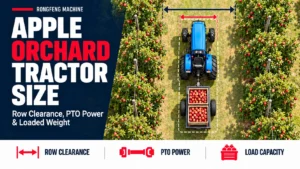
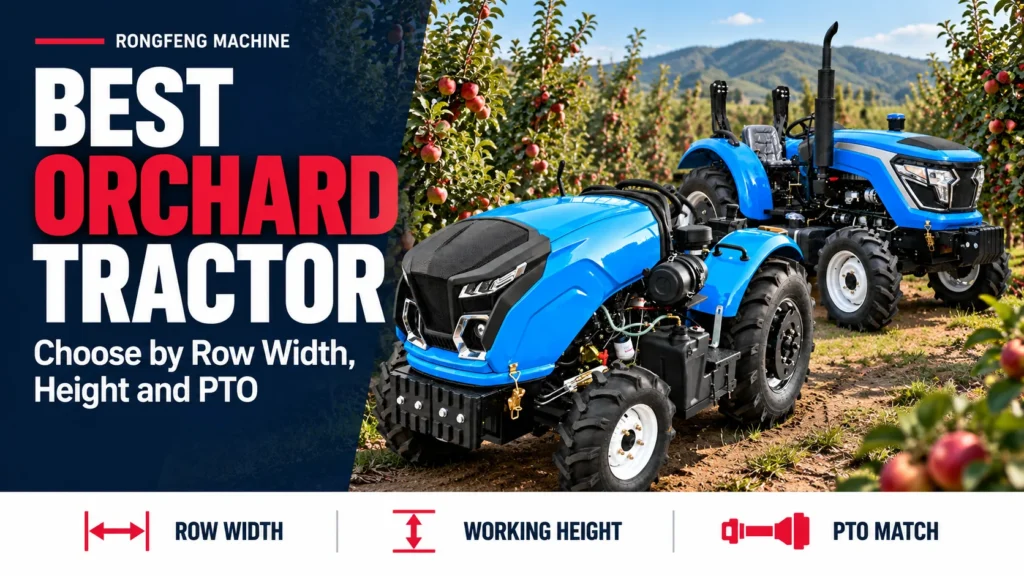
The best orchard tractor clears your rows and canopy, supplies the PTO (power take-off) output your implements require, and suits your main jobs. If either width or height excludes a standard compact, compare narrow or low-profile frames. If both clearances are sufficient and loading, tillage or transport dominates, compare standard compact or utility frames.
Quick recommendation: which tractor type should you compare first?
| Orchard scenario | First type to compare | Key checks | When it is a poor fit |
|---|---|---|---|
| Narrow rows, low branches, or both | Narrow or low-profile tractor addressing the actual restriction | Configured tractor and implement width; working height; turning space | It still fails clearance, implement or operating checks |
| Spraying is the main job | Tractor matched to the sprayer; consider a filtered cab if it clears the canopy | Verified PTO output and speed; loaded weight, hitch and hydraulics; pesticide-label protection | Only engine horsepower is known, or the sprayer and protective equipment cannot be matched |
| Orchard work plus regular loading and transport | Standard compact or utility tractor, if orchard clearance permits | Loader fit, capacity and ballast; tractor and implement clearance; trailer requirements | Loader capacity is suitable but the machine cannot enter the orchard |
| A small orchard with light tasks | Compact, subcompact or walk-behind equipment matched to the tasks | Access, turning space and required implements | PTO, hitch, lift or traction is insufficient; small acreage alone does not prove a match |
Use these recommendations to shortlist a type. The model dimensions below support initial screening; they do not confirm an orchard-and-implement match.
What makes an orchard tractor the best fit: five measurements to take first
Record these five items for each orchard block, including gates and the route between blocks:
- Clear row width: the narrowest free width between trees, trellis posts or wires, at wheel and implement height (not trunk-to-trunk row spacing).
- Lowest branch or wire height along the tractor’s travel line.
- PTO demand: the horsepower range and input speed your sprayer and mower makers state.
- Work outside the rows: yearly hours of loader, tillage and trailer work.
- Headland and slope: the turning depth at row ends, and any side slope.
Row width: fit the tractor, tires and implement to your clear row width
Clear row width is the narrowest free passage at tractor and implement height, not the trunk-to-trunk spacing. Compare it with the widest part of the configured tractor or implement, then allow steering margin and clearance from the root zone. An implement such as a PTO rotary mower may be wider overall than its working width; request both dimensions.
Wheel track is the center-to-center distance between left and right wheels. Adjustment depends on the maker’s permitted range and tire size. Narrowing the track generally reduces lateral stability, all else being equal.
How to measure clear width and headland turning space
- In each block, find the tightest row.
- Measure the free width at wheel-hub height, implement height and operator and roll-bar height. Between trellis posts, measure post face to post face and note any anchors or wires that lean into the lane.
- Record the narrowest number as the block’s clear width.
- If you already drive a tractor or ATV there, run the tightest row at working speed and mark how far you wander from center. That wander is your minimum margin on each side.
Measure headland depth from the last trunk to the nearest fence, ditch or road. Allow for the turn, implement swing and stopping space. Neither 50 HP source sheet states turning radius; request the test method, wheel-track setting and whether steering brakes were used.
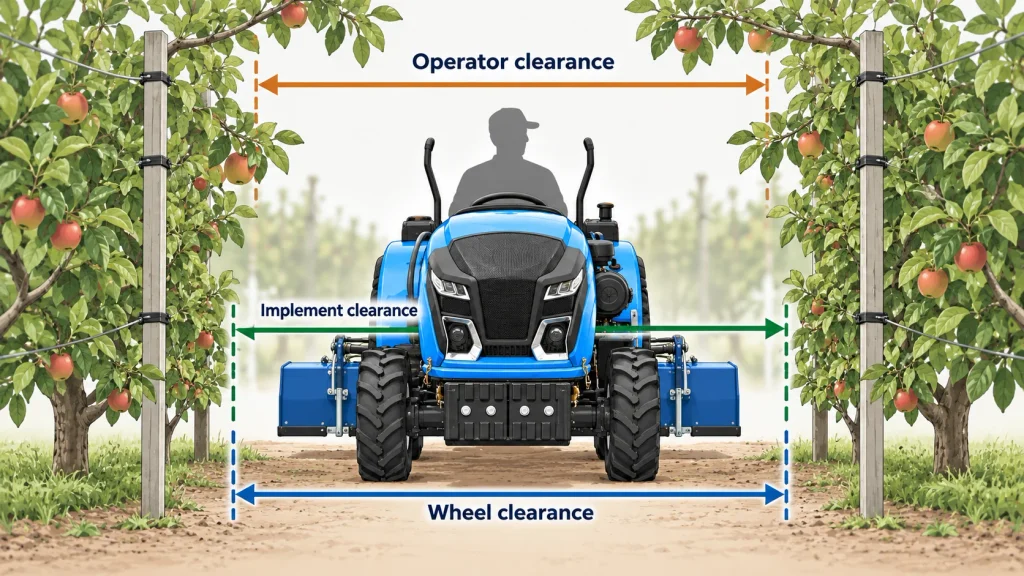
Same 50 HP, two frames: what the orchard-type build changes in width
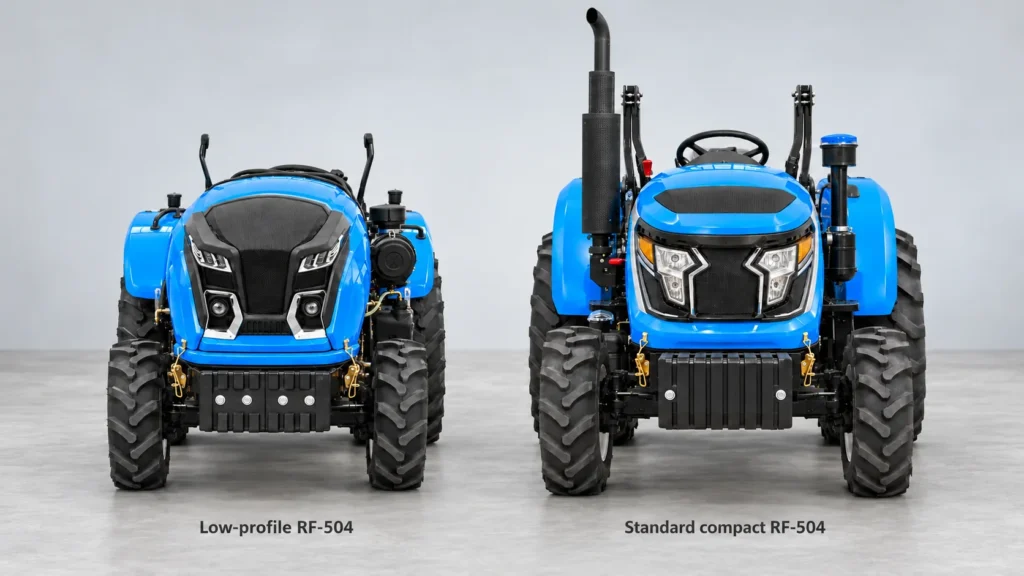
Rongfeng Machine publishes specifications for two 50 HP (36.8 kW) four-wheel-drive tractors with different frames. The 50 HP low-profile 504 is 2500 × 1200 × 1200 mm (98 × 47 × 47 in), with a 1550 mm (61 in) wheelbase and 9.50-16 rear tires. The standard compact RF-504 is 3200 × 1500 × 1930 mm (126 × 59 × 76 in), with an 1800 mm (71 in) wheelbase and 11.2-24 rear tires.
Both sets of figures are manufacturer specifications. Use the configured dimensions, rather than the model’s engine horsepower alone, to check orchard access.
At the same 50 HP rating, the low-profile RF-504 is 300 mm (12 in) narrower and 700 mm (28 in) shorter than the standard compact RF-504. Across Rongfeng’s low-profile series, width increases from 1200 to 1300 mm (47 to 51 in) between 50 and 100 HP: a 100 mm change, compared with the 300 mm gap between the two 50 HP frames. These differences are calculated from the manufacturer specifications.
Canopy height: overall height, ROPS and exhaust under low branches
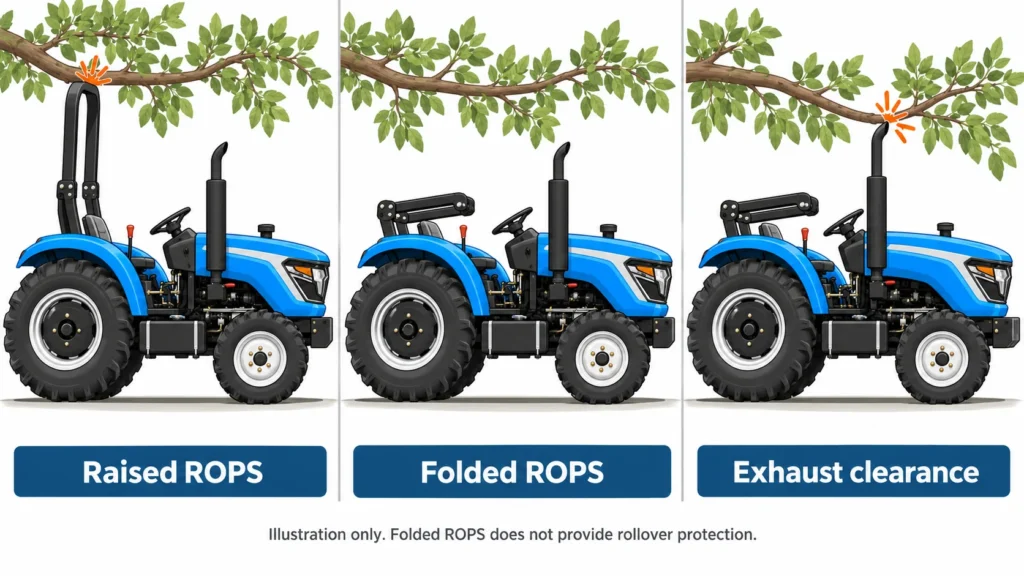
Working height is the highest point of the tractor as operated, including the seated operator, ROPS (roll-over protective structure), exhaust, sunshade or cab. Compare that height with your lowest branch or wire, allowing overhead clearance. The low-profile models below list 1200–1300 mm (47–51 in), versus 1930 mm (76 in) for the standard RF-504, without specifying ROPS position. Confirm raised and folded ROPS heights and the exhaust height.
Rear-mounted, mid-mounted or foldable ROPS
A ROPS protects the operator in a rollover when raised and used as specified. Colorado State University’s HICAHS, in a NIOSH-funded project, reports that multi-step foldable ROPS often remain lowered, leaving the operator without rollover protection.
Follow the operator’s manual for any permitted ROPS folding, and raise and lock it as soon as the clearance restriction ends. Use the seatbelt as the manual specifies for the ROPS position. A lowered ROPS provides no rollover protection.
ROPS mounting position alone does not establish folded height: pivot point and bar length matter. Confirm raised and folded heights and the locking procedure. A low build does not cancel the stability effect of a narrow wheel track; follow the model’s slope limits.
U.S. ROPS requirements and low-clearance uses
For U.S. employers, 29 CFR 1928.51 sets ROPS and seatbelt requirements for agricultural tractors manufactured after October 25, 1976, subject to its specified exceptions. Its legal definition of a low profile tractor includes equal front and rear wheel spacing, chassis clearance no greater than 18 inches (457 mm), a hood no higher than 60 inches (1524 mm), and an operator who straddles the transmission.
The rule provides exceptions for defined low profile tractors in qualifying orchard, vineyard, hop-yard, farm-building or greenhouse uses, including use incidental to that work. A manufacturer’s low-profile label alone does not establish that an exception applies. The rule also requires removed ROPS to be remounted. Check the applicable local requirements alongside the operator’s manual.
Orchard-type envelopes from 50 to 100 HP (reference table)
| Model (rated power) | Listed L × W × H | Wheelbase | Rear tire |
|---|---|---|---|
| RF-504 / RF-604 (50 / 60 HP) | 2500 × 1200 × 1200 mm (98 × 47 × 47 in) | 1550 mm (61 in) | 9.50-16 |
| RF-704 (70 HP) | 2550 × 1300 × 1300 mm (100 × 51 × 51 in) | 1860 mm (73 in) | 9.5-16 |
| RF-804 (80 HP) | 2800 × 1300 × 1300 mm (110 × 51 × 51 in) | 1560 or 1860 mm (61 or 73 in) | 9.5-16 |
| RF-1004 TB / TE (100 HP) | 3180 / 2900 × 1300 × 1300 mm (125 / 114 × 51 × 51 in) | 2050 / 1950 mm (81 / 77 in) | 13.6-16 |
Source: Rongfeng manufacturer specifications, checked in October 2026; not independently tested or compared across brands. Dimensions depend on configuration. TB and TE are the two listed versions of the RF-1004. All list 210 mm (8 in) ground clearance; ROPS type and position, sunshade and exhaust height are not stated. Imperial values are converted and rounded.
This dimension table is for initial screening. It does not verify working height, turning clearance or implement suitability. Engine, transmission and PTO specifications are available on the low-profile orchard and greenhouse tractors (50–120 HP) page; the missing confirmation items are listed in the supplier checklist below.
Horsepower and PTO: size the tractor from the sprayer and mower, not the acreage
Match tractor PTO output to the most demanding implement, with the margin its maker recommends. University of Georgia specialist Paul E. Sumner advises choosing toward the upper end of a sprayer’s suggested horsepower range. Check frame size as power increases: the low-profile RF-504 and RF-1004 TB have lengths of 2500 and 3180 mm (98 and 125 in), and weights of 1250 and 1700 kg (2,756 and 3,748 lb).
Engine horsepower vs PTO horsepower
PTO horsepower is power at the shaft after drivetrain losses, so engine horsepower alone cannot establish implement compatibility. There is no fixed deduction that reliably converts the two. Neither 50 HP source sheet provides PTO horsepower; request the output figure and measurement method.
PTO speed and spline: confirm the implement input before you buy
PTO speed is the rated shaft speed in rpm. The low-profile RF-504 specifies 540/720 rpm; the RF-1004 TB specifies 540/720 with optional 540/1000; the standard RF-504 specifies 540/760 on a 6-spline shaft. Confirm the low-profile shaft connection and match the implement’s input speed. Never exceed its rated input speed.
The Standards Council of Canada record for ISO 500-1:2014 states that it covers rear PTOs on tractors with a track setting above 1150 mm (45 in), while narrower tractors fall under ISO 500-2. Confirm the applicable PTO standard and the physical connection for the configuration you order.
Before the first hitch, with the engine off and the PTO disengaged, check the spline count and shaft size, the rotation direction, the driveline length at the highest and lowest hitch positions, and that the master shield and implement guards are in place.
Spray-led orchards: matching an air-blast sprayer to the tractor
For spray-led orchards, check four things. An air-blast sprayer uses a fan to carry spray into the canopy; the tractor-mounted air-blast orchard sprayer has a large rear fan and perimeter nozzles.
- Power: size toward the top of the sprayer maker’s horsepower range.
- Speed: the University of Georgia bulletin stresses keeping “consistent engine speed so the RPMs of the sprayer PTO remain in the range needed.”
- Weight: calculate empty sprayer weight plus a full tank; water weighs about 1 kg/L (8.3 lb/US gal). Confirm lift capacity at the relevant load position and ballast for a mounted sprayer. The source sheets do not provide rear lift capacity. A trailed sprayer reduces the lifted load but still needs its drawbar and transport requirements checked.
- Width: the sprayer must fit your clear row width with the same margin as the tractor.
Confirm these figures before choosing the tractor. Spray exposure also affects the cab choice.
Cab, sunshade or open station for spraying under trees
Choose the operator station for both spray exposure and canopy clearance. Follow the pesticide label and local requirements. For U.S. agricultural handlers, 40 CFR 170.607(e) allows conditional enclosed-cab PPE exceptions. A label-required filtering facepiece or dust/mist respirator may be omitted only with ventilation operated and maintained to the maker’s instructions; other required respirator types must still be worn. Keep label PPE in a sealed container and put it on when leaving the cab in a treated area during application or a restricted-entry interval. An open station or sunshade does not qualify for these cab exceptions.
Check dimensions with the cab fitted. The standard RF-504 offers fan or air-conditioned cabs; the low-profile version lists a sunshade. Neither option name establishes spray filtration: confirm the filter, maintenance schedule and configured height.
Where the canopy permits, compare enclosed cabs with suitable filtered ventilation. Where it does not, confirm that an open-station configuration and the required PPE suit the application before selecting it.
Is an orchard tractor usable as a utility tractor?
Yes, an orchard tractor is usable as a utility tractor for mowing, light tillage and trailer work, but its low, narrow frame gives up ground clearance, tire size and margin for loader and heavy tillage work.
| Item | RF-504 low-profile build (listed) | RF-504 standard compact (listed) | What it means outside the rows |
|---|---|---|---|
| Overall L × W × H | 2500 × 1200 × 1200 mm (98 × 47 × 47 in) | 3200 × 1500 × 1930 mm (126 × 59 × 76 in) | The smaller frame fits tight rows; the larger needs more clearance |
| Machine weight | 1250 kg (2,756 lb) | 1350 kg (2,976 lb) | 100 kg (220 lb) lighter; heavy front or rear implements need ballast checked |
| Wheelbase | 1550 mm (61 in) | 1800 mm (71 in) | Shorter wheelbase may help in tight turns; turning radius is not listed, so ask for it |
| Tires (front / rear) | 600-12 / 9.50-16 | 6.5-16 / 11.2-24 | 24-inch rims take a larger tire; ask for overall tire diameter and ground clearance |
| Ground clearance | 210 mm (8 in) | Not listed | Ask before comparing |
| PTO speeds | Dual 540/720 rpm | 540/760 rpm, 6 splines | Match each implement’s input speed |
| Hydraulic outputs | “High-pressure hydraulic output”; number not listed | 2 groups | Ask how many outlets (remotes) there are and how a loader valve would be connected |
| Optional equipment | Paddy wheels; sunshade | Front and rear ballast; sunshade; fan cab; air-conditioned cab; flat floor; air pump | Ballast and cab options matter for loader and spray work |
Source: Rongfeng manufacturer specifications, checked in October 2026. This compares the two 50 HP configurations, not independently measured performance.
In the manufacturer specifications, the low-profile RF-504 is 100 kg (220 lb) lighter and uses 16-inch rear rims instead of 24-inch rims. The 50 HP standard compact 504 page gives the larger frame’s details. The stated applications are low-clearance row work for the low-profile model, and orchard rows, smallholdings and light tillage for the standard model.
For loader work, confirm approval for the exact tractor model, the loader’s rated load and lift height, and required ballast. If loading and heavy tillage dominate, compare standard frames or separate equipment, while retaining the orchard clearance checks.
Before you order: what to confirm on the spec sheet and the support plan
Use the comparison to shortlist, then request written specifications for the configuration you intend to order:
- Height with the ROPS raised and folded, and with any sunshade or cab.
- Tire options, wheel-track range and turning radius.
- PTO horsepower, PTO speeds, spline count and shaft size.
- Rear hydraulic outlets (remotes), 3-point hitch category and rear lift capacity at the hitch balls.
- ROPS type and fold mechanism.
- Engine make and model. The low-profile RF-504 sheet lists a “Laidong / Weifang engine”, so ask which one your unit will carry.
- For a U.S. purchase, the EPA certificate of conformity covering that engine or the equipment.
- A parts list with per-item lead times, the warranty terms and the manuals.
Evidence needed before confirming a model
Neither 50 HP source sheet gives PTO output horsepower, the ROPS position included in its height, or turning radius. Obtain:
- Measured working height: level ground, tire and accessory configuration, ROPS position, highest point and open-station operator clearance.
- PTO confirmation: output horsepower and measurement method, rated speed, splines and shaft size.
- Turning evidence: radius or diameter, test method, tire and track settings, brake use and implement swing.
- A documented pairing: orchard dimensions and headland space, implement power and loaded weight, and final tractor configuration.
The sources supplied for this guide contain no such measurement record, turning test or customer pairing. The tables remain initial-screening data.
For U.S. buyers, 40 CFR 1068.301 generally requires imported engines and equipment to be covered by a certificate of conformity, subject to the exemptions and exclusions specified in the rule. U.S. Customs and Border Protection may stop a noncompliant import, and the importer must complete the required EPA declaration. Ask for the certificate and confirm that its engine family covers the engine you will receive.
Match PTO output and speed, hitch category, pin sizes, hydraulics, load position, lift capacity and ballast to each implement. Require a pre-shipment report identifying the unit and engine, plus manuals and the agreed parts list. Do not release a deposit while the configuration, required documents or support terms remain unresolved.
Confirm locally available filters, belts and seals and whether a nearby mechanic can service the engine. See warranty, spare parts and export documents. Dealers and importers can discuss an OEM configuration for dealers around their customers’ requirements.
Orchard-type shortlist: either clearance restriction is sufficient
- The standard tractor or intended implement cannot pass through the row with the required side margins. The standard RF-504 has a catalog width of 1500 mm (59 in), before margins or a wider implement.
- Its working height, including the operator, raised ROPS and accessories, cannot clear the lowest branch or wire with overhead allowance.
A shortlisted candidate must pass all checks: configured width and height, turning space, PTO output and speed, hitch and hydraulics, loaded implement capacity, ballast and operating limits.
Standard compact or utility shortlist: clearance first, then workload
First confirm that both row-width and working-height clearances pass. Within those candidates, favor a standard frame when regular loading, tillage or transport dominates, or when its tire and ground-clearance options better suit the route. Implement and operating checks still apply. Rough or wet ground cannot override failed clearance.
Two machines or hired work
Consider separate equipment if orchard clearance rules out the frame needed for regular heavy work and no confirmed configuration meets both jobs. For very tight plots, compare smaller equipment. Follow the manual’s slope limits with any frame.
Get help matching a tractor to your orchard
Send clear row width, lowest branch or wire height, headland space, implement models or nameplate photos, main jobs and destination country. Include loader and trailer requirements.
Get an Orchard Tractor Recommendation
Rongfeng quotes by power, transmission, implements and quantity, including single-unit orders. Confirm landed cost, warranty, spare parts and lead times for your destination in the quotation, contract or PI.
FAQ
Which tractor brand is the most reliable for orchard work?
Independent orchard-specific reliability data is not available in this guide. Compare fit, documented capability, parts availability and local service before choosing a brand.
How much horsepower does a small orchard need?
Use the sprayer and mower makers’ stated PTO requirements, with their recommended margin, to shortlist tractors that also fit your rows. Acreage alone does not set horsepower.
Do I need 4WD in an orchard?
Four-wheel drive can help traction on wet ground and with loader work. Both 50 HP models here are 4WD, but 4WD does not establish lateral stability or a safe slope angle; follow the operator’s manual.
Which orchard tractor setup to choose: decision rules
If a standard compact fails either row-width or working-height clearance, shortlist a narrow or low-profile frame that addresses that restriction. Every candidate must still pass all clearance and implement checks.