
Farm tractor cost starts with the machine, but your purchasing budget also needs the equipment, transport and local charges required to put it to work. After delivery, fuel, maintenance, repairs and ownership costs determine what each working hour costs. Compare tractors using the same specification, delivery point and expected workload.
How much does a tractor cost to buy?
In Rongfeng’s export business, basic tractor quotations are commonly a few thousand US dollars. Some orders reach around US$10,000–20,000 after selected equipment and transport are added. These October 2026 estimates vary by configuration and destination. Confirm taxes, clearance and final delivery for your shipment.
To judge whether your own budget is realistic, split it into four parts:
| Budget part | What to include | What to request |
|---|---|---|
| Tractor | Exact model, engine, drive, transmission, tires and operator station | A written specification and base-machine price |
| Equipment | Loader, bucket, ballast, hydraulic options and required implements | Included equipment identified; additions priced separately |
| Delivery and setup | Packing, freight, insurance, destination handling, clearance, applicable taxes, inland delivery and assembly | Named delivery point and an included/excluded list |
| Use and ownership | Fuel, service, repairs, labor, depreciation, capital cost, insurance and storage | A yearly budget based on your expected hours |
Compare written quotations for the same machine and equipment, delivered to the same location.
What changes the cost of the tractor and its equipment?
Horsepower matters, but it is only one line in the specification. A useful quote also identifies the drive, cab, hydraulic connections and equipment needed for your work.
| Cost driver | Compare these details | Question for the supplier |
|---|---|---|
| Power and drivetrain | Engine power, available PTO power, 2WD or 4WD, and transmission | Does this specification match the intended implement and workload? |
| Operator station | Open station, canopy or cab; ventilation or air conditioning | Which version is included in this price? |
| Loader package | Loader, mounting frame, bucket, controls and necessary ballast | Is this a complete fitted package, and what remains extra? |
| Implements | Type, working width, hitch, PTO requirements and hydraulic needs | Which compatible implement is included, at what separate price? |
| Tires and ballast | Tire size and type, weights and application suitability | Are the quoted tires and weights the ones needed for the job? |
| Support | Written warranty coverage, parts supply and service arrangements | Who pays for parts, labor and transport if a repair is needed? |
Do not substitute engine horsepower for PTO horsepower when checking an implement’s power requirement. PTO speed and spline count describe the connection; they do not state the power available at that connection.
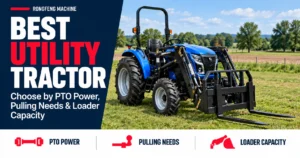
Use the utility tractor specifications to build a comparison, and list tractor implements and attachments separately. For help selecting the configuration, see how to choose a utility tractor.
New, used and imported tractors: compare the same buying budget
Compare the purchase price together with repairs, preparation and delivery costs.
| Offer | Starting figure | Costs or evidence to check |
|---|---|---|
| New from a local dealer | Written selling price for the specified configuration | Tax, delivery, setup, included implements and local warranty service |
| Used from a local seller | Asking price, supported by inspection and comparable local offers | Immediate repairs, tire condition, service history and transport |
| New or used through an import purchase | Quotation with a named trade term and destination | Remaining logistics, import requirements, local setup, parts and support |
For a used tractor, estimate resale value and future repairs from its expected age, accumulated hours and condition when you sell it. Include its current age and hours in that calculation. Budget work needed immediately as a purchase-related cost, then allow for future maintenance and repairs separately. A lower asking price can lose its advantage if it needs tires, hydraulic work or an engine repair before the first job.
For a new tractor, compare the written warranty and actual service arrangements alongside the machine price. A stated warranty period alone does not explain parts coverage, labor charges or the cost of returning a failed component.
How to calculate the cost of an imported tractor at your site
Delivered and prepared purchase cost = quoted tractor and equipment total + all required costs not already included to reach your site and prepare the machine.
Keep the named place or port beside the price. EXW identifies a place of delivery; FOB identifies a port of shipment; CIF identifies a destination port and includes the seller’s cost, insurance and freight obligations under that term. Put the agreed Incoterms version and required documents in the contract. The International Trade Administration’s Incoterms guide explains these distinctions.
Complete the remaining lines with your supplier, forwarder and destination broker:
| Cost line | How to handle it |
|---|---|
| Export packing and origin transport | Add only the portion outside the supplier’s quote |
| International freight and cargo insurance | Confirm route, shipment details, coverage and inclusion |
| Destination handling and clearance | Obtain the destination agent’s written charges; identify possible storage charges |
| Duties, taxes and required documents | Confirm the classification, origin, destination rules and entry date for this machine |
| Delivery to your site | Quote the actual route, unloading arrangements and final address |
| Assembly and pre-delivery checks | Price any work needed after unpacking and before operation |
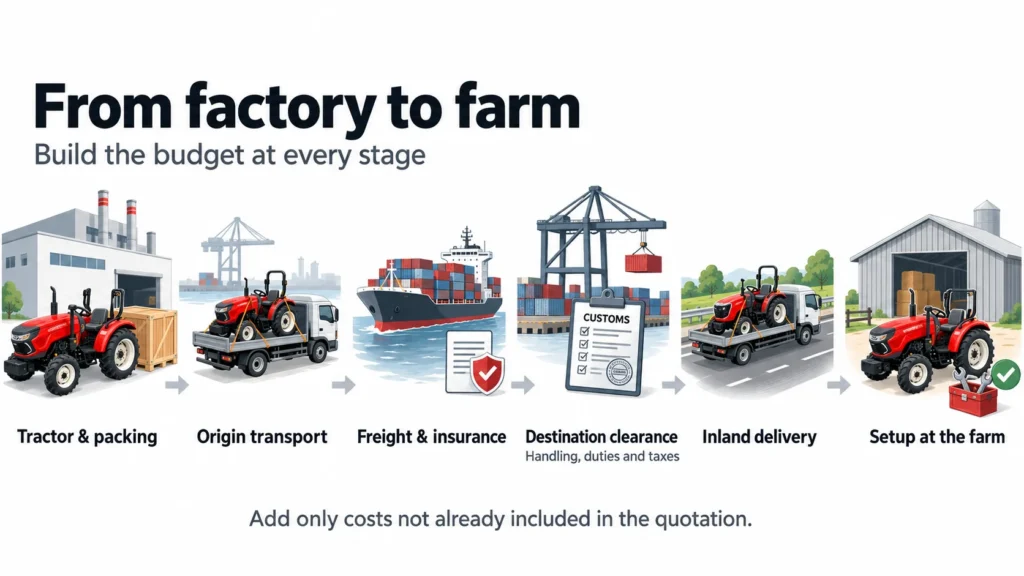
An unpriced line is an unknown, not a zero. Conversely, adding freight again to a quote that already includes it overstates your budget.
For a multi-unit shipment, calculate per-unit acquisition cost = that unit’s purchase price + its allocated share of shipment charges + its own destination and preparation charges. Equal allocation may suit identical units; mixed tractors and implements may need a different allocation based on their packed space or weight.
For U.S. destinations: confirm the engine’s applicable EPA certification and labeling, or a valid exemption, before ordering. A quotation does not establish import eligibility, and used equipment is not automatically exempt. See 40 CFR 1068.101. Have the broker confirm the applicable tariff classification and total charges for the entry date using the U.S. Harmonized Tariff Schedule.
Quotation example: separating the machine from shipping-related charges
A Rongfeng quotation dated 13 October 2026 lists one RF 704 wheel tractor, described as 70 HP, 4WD, with a Weifang 490 engine, a six-spline PTO and hydraulic steering. It names Qingdao as the loading port and Tema, Ghana, as the destination port, with a stated validity of 15 days.
| Quoted item | Amount, USD | Scope shown on the quotation |
|---|---|---|
| RF 704 tractor | $3,950 | EXW machine price for the quoted specification |
| Combined packing and logistics charge | $939 | Machine packing, logistics to the China port and shipping to Tema port |
| Stated CIF total to Tema | $4,889 | $3,950 + $939; the quotation’s port-based total |
The $939 line combines several costs; it is not an ocean-freight-only rate. Although the total is labeled CIF, insurance is not itemized, so obtain the coverage details and insurance document. No implement is separately priced or specified as included in this example.
The quote does not itemize destination clearance, import duties or taxes, destination handling, or inland delivery to the farm. Confirm which are payable and obtain their amounts. For this case, the budget continues as $4,889 + applicable destination and site-preparation costs not already included, plus any additional equipment required.
What does a tractor cost to run each year?
Calculate fuel, service, repairs and operator time from the work you expect to do. Keep these operating costs separate from ownership costs such as depreciation, capital cost, insurance and storage. This distinction is also used in Iowa State University Extension’s Estimating Farm Machinery Costs, revised March 2026.
Fuel and lubrication
For each main task, multiply expected hours by fuel use per hour and your local fuel price. Add the task totals. Use refueling records and hour-meter readings from comparable work to estimate consumption.
Price lubricants separately unless they are already included in the maintenance budget.
Scheduled service and repairs
Request the maintenance schedule for the exact engine and tractor supplied. List the services that fall due during the year, including recurring work and any calendar-based deadlines.
Ask for parts, fluids, labor and service travel on the same basis. Include work you do yourself by assigning time and consumables to it. Where service jobs overlap, confirm what is already included in the larger service before adding both totals.
Keep an allowance for unscheduled repairs, informed by condition, repair history and parts quotations. If an estimate already includes routine service, do not add the same service a second time. Also consider the cost of a replacement machine or hired operator if a breakdown would interrupt time-sensitive work.
Labor and movement between jobs
Count operator time for preparation, travel, operation and cleanup. Owner-operated work still uses time; show its assigned value when comparing ownership with hiring a contractor. Paid wages belong in the cash budget, while unpaid owner time belongs in the economic comparison.
If you transport the tractor between sites, add the relevant haulage or trailer costs. Use your insurer’s quote and your actual storage costs for the ownership budget.
How to calculate farm tractor cost per hour
Farm tractor cost per hour = (annual ownership cost + annual operating cost + annual labor cost) ÷ annual working hours.
Use the same definition of working hours throughout. Include preparation and travel in labor costs even if those hours are outside the working-hour denominator.
| Worksheet line | Input or calculation |
|---|---|
| Acquisition cost | Tractor and equipment, delivered and prepared; include each purchase-related cost once |
| Holding period | Years you expect to keep the machine from today |
| Expected resale value | Estimate for its age, accumulated hours and condition at the end of that period |
| Average annual depreciation | (Acquisition cost − expected resale value) ÷ holding period |
| Annual capital cost | A consistent allowance for borrowing and money invested; avoid counting both on the same funds |
| Other annual ownership costs | Applicable recurring taxes, insurance and allocated storage costs |
| Annual operating costs | Fuel, lubricants, scheduled service, unscheduled repairs and job-related transport, without overlap |
| Annual labor cost | Total operator hours × the wage or assigned value of that time |
| Annual total | Depreciation + capital cost + other ownership costs + operating costs + labor |
| Cost per working hour | Annual total ÷ annual working hours |
Include implement ownership and repair costs once if both alternatives include implements; exclude them consistently if comparing tractors alone.
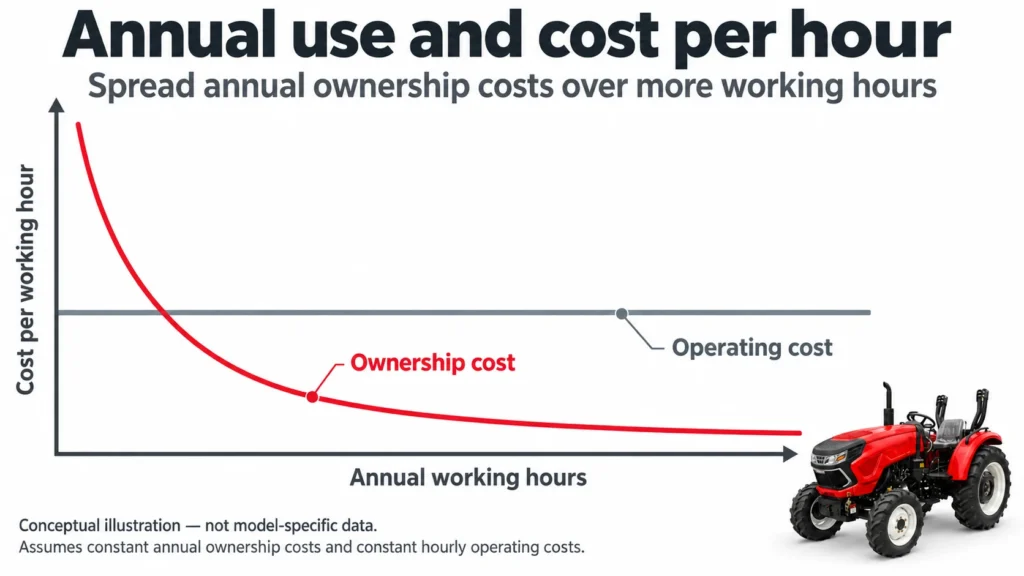
An illustration of why annual hours matter
For a hypothetical tractor budget, assume annual ownership costs of $1,500, operating costs of $5 per working hour, and labor costs of $6 per working hour including preparation time.
| Calculation | 200 working hours/year | 400 working hours/year |
|---|---|---|
| Ownership costs | $1,500 | $1,500 |
| Operating costs | $1,000 | $2,000 |
| Labor costs | $1,200 | $2,400 |
| Annual total | $3,700 | $5,900 |
| Total per working hour | $18.50 | $14.75 |
The second case costs more per year but spreads ownership costs over more work. Both cases use the same annual ownership budget and hourly rates; adjust repair costs and resale value if heavier use changes them.
Keep a separate cash-flow schedule for deposits, balance payments, freight, tax, loan payments and operating bills. Depreciation is not a bill paid that year. Do not add loan principal repayments to depreciation in the economic-cost total, or count the purchase price again every year. Compare financing offers using their written price, interest, fees and payment dates.
FAQ
Buying a cheap 4WD tractor: what to check
A cheap 4WD tractor is worth considering when its specification, delivered cost and support fit the work. Compare the complete usable package: a low machine price can become a different budget once the required implement, freight and local preparation are added.
Is the cheapest 4WD tractor the cheapest to own?
Not necessarily. Compare quotations using the same equipment and delivery point, then estimate ownership and running costs at your expected hours. Check parts availability, repair arrangements and resale evidence.
How much do tractors cost with a loader or other implements?
Add the separately quoted equipment and any required mounting, hydraulic or ballast components to the tractor price. Check whether the larger package changes packing and freight.
Does CIF mean the tractor is delivered to my farm?
No. A CIF quote names a destination port. Confirm destination charges, import clearance, applicable duties and taxes, and onward delivery separately. Ask for a quote to your actual site if that is the figure you need to compare.
Request a budget for your own configuration. Send Rongfeng your main tasks, preferred horsepower or model, required implements, quantity, destination port and final delivery location through rongfengmachine.com. Ask for the equipment list, trade term, quote validity and remaining buyer-paid costs.