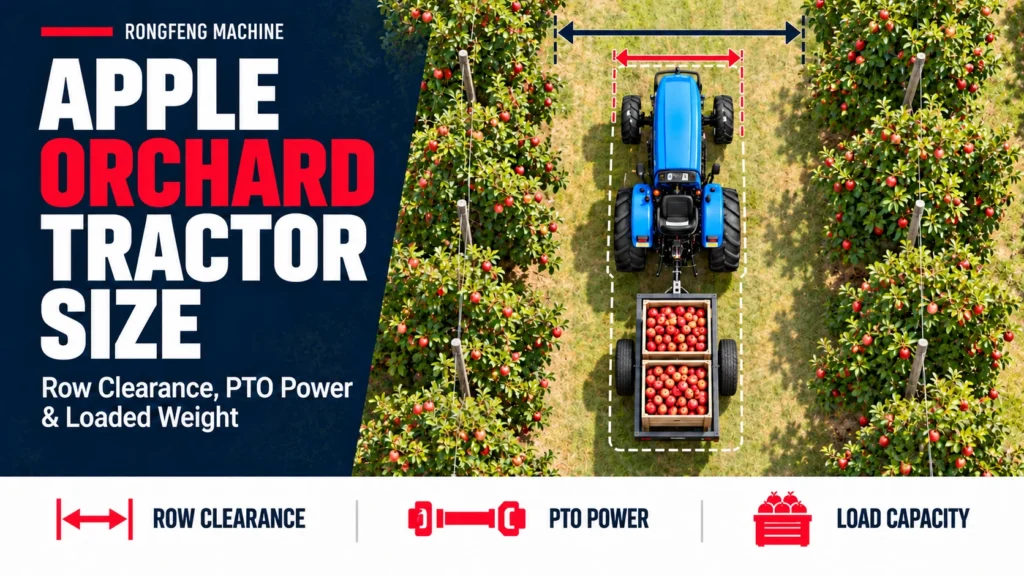
What Size Apple Orchard Tractor Do You Need?
Size an apple orchard tractor around its widest working setup, the sprayer’s PTO demand and the heaviest load it must handle. Measure the clear passage between mature canopies first, then match the tractor to the power and load requirements of each implement. The checks below help you choose a frame that fits and decide whether one tractor can cover spraying, mowing and harvest transport.
The Season’s Jobs and What Each One Asks of the Tractor
Spraying is often the job that sets the size of a tractor for an apple orchard. The Practical Guide for Organic Apple Production, hosted by the University of Vermont (UVM), gives spraying its own tractor role because an air-blast sprayer needs PTO power as well as capacity to carry or tow a full tank. In a small planting using a self-powered sprayer on a UTV, the mower may set the tractor’s power requirement instead. Mowing also asks for reach and compatible hydraulics, while bins ask for towing or lifting capacity.
The PTO (power take-off) shaft drives fans and blades, the three-point hitch carries mounted implements, and rear hydraulic outlets (remotes) move cylinders such as a mower’s offset.
| Job | Implement | Driven by | What it asks of the tractor |
|---|---|---|---|
| Shredding prunings and leaf litter | Flail mower, often offset | PTO, three-point hitch | PTO power for the selected mower and material being chopped |
| Spraying, repeated through the season | Air-blast or handgun sprayer | PTO for tractor-powered models; hitch or drawbar | The sprayer’s specified PTO power and input speed; capacity for the loaded sprayer |
| Alley and under-canopy mowing | Rotary or flail mower | PTO, hitch; hydraulics for powered offset or tilt | Cutting width, reach and clearance; compatible hydraulic controls |
| Spreading fertilizer, mulch or compost | Spreader | PTO; hitch or drawbar, depending on the model | Drive requirements and capacity for the loaded implement |
| Moving harvest bins | Bin trailer, forks or forklift | Drawbar, hitch or front loader | Rated payload and braking for trailers; lift capacity at the bin’s load position |
Leave out the jobs that happen once per block. The same guide notes that site preparation, planting and trellis-building equipment can be rented or hired. On your list, the job with the highest PTO demand sets the power floor, and the narrowest alley that one of those jobs enters sets the width ceiling.
Tractor Width by Planting System: Tall Spindle, Dwarf, Semi-Dwarf and Standard Trees
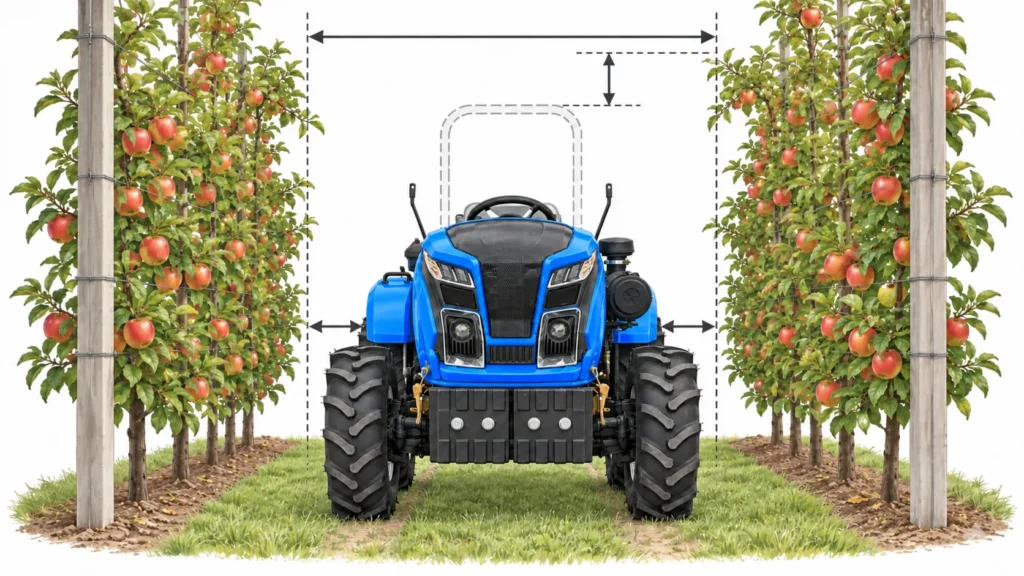
Measure the passage left between mature canopies, including trellis posts and end anchors. Published planting spacings help you understand the likely equipment class, but the clear passage and the widest part of your working setup decide the fit.
Harry Hoch’s Organic Orchard Planning, published by MOSES in 2012 and hosted by Michigan State University, gives equipment-width guidance for Upper Midwest orchards. The tall-spindle fact sheet hosted by UMass Amherst describes an optimum planting spacing of 3 × 11 ft (0.9 × 3.4 m), with 4 × 12 ft (1.2 × 3.7 m) as its maximum.
| Planting system | Between-row spacing in the cited guide | Equipment check at maturity |
|---|---|---|
| Tall spindle | 11 ft optimum, 12 ft maximum in the tall-spindle fact sheet | Measure the passage between the trained canopies, posts and anchors |
| Full dwarf | 12–14 ft (3.7–4.3 m), Hoch/MOSES | The guide suggests equipment about 4 ft (1.2 m) wide or narrower; check your actual passage |
| Dwarf | 16–20 ft (4.9–6.1 m), Hoch/MOSES | The guide discusses utility tractors up to about 7 ft (2.1 m); include the implement’s outside width |
| Semi-dwarf | 20 ft (6.1 m) or more, Hoch/MOSES | Check mature branch and fruit clearance along the equipment route |
| Standard and semi-standard | 24 ft (7.3 m) or more, Hoch/MOSES | Check the complete tractor-and-implement combination, especially during harvest |
In tall-spindle blocks, size the tractor and its widest implement to the measured passage, allowing room to steer without brushing fruit or branches. A 4-ft equipment class from a full-dwarf planning guide is not a universal limit for tall spindle.
Rongfeng’s low-profile RF-504 greenhouse tractor and RF-604 are both listed at 1,200 mm (47 in) wide. The RF-704, RF-804 and RF-1004 TB/TE are listed at 1,300 mm (51 in). The narrower frames give you a starting point for comparison, but the working width includes the selected tires, wheel-track setting and attachment. On a trailer, measure the outside of the wheels as well as the box.
Overhead clearance is the second check. Measure the tractor in its working configuration, including the raised ROPS (roll-over protective structure) and any sunshade or cab. Compare that height with the lowest branches and wires on the route. Keep the ROPS raised and the seat belt fastened; use a different route or adjust the orchard clearance when the protected tractor cannot pass.
More engine horsepower can also bring a longer, heavier frame. From the 50 HP RF-504 to the 100 HP RF-1004 TB, listed width increases by 100 mm (4 in), while wheelbase increases from 1,550 to 2,050 mm (61 to 81 in) and machine weight from 1,250 to 1,700 kg (2,756 to 3,748 lb). Compare turning space with the implement attached, including its swing at row ends. On slopes, use the manufacturer’s permitted wheel settings, ballast and operating limits.
For the field method behind these checks, see how to measure clear row width, canopy height and PTO demand.
Planting a New Block: Set Row Spacing and Tractor Width Together
If you’re planting a new block, choose the row spacing and the equipment line together. Allow for the mature canopy, headland turns and the route used by full bin trailers. In his 2006 presentation on modern apple training systems, Cornell’s Terence Robinson suggested 12–13 ft (3.7–4.0 m) between rows on slopes and 10–11 ft (3.0–3.4 m) on level ground for the systems discussed. Use those as planning examples and lay out the machinery route for your own terrain.
Spraying Sets the Power: PTO Horsepower, Tank Weight and Slopes
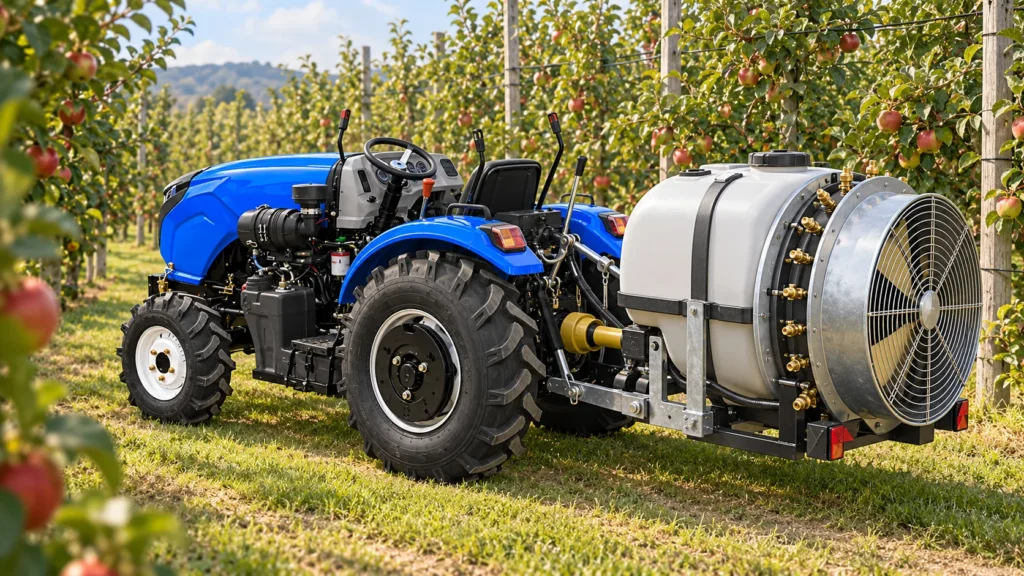
Check the spray job in three parts: tank capacity for the area between refills, the loaded sprayer’s weight, and its PTO power requirement. Then check slopes, row-end turns and operator protection.
Air-blast sprayers are common in commercial apple orchards. UVM notes that they generally take less time and water than handgun sprayers, but need more horsepower. A tractor-mounted air-blast orchard sprayer uses a fan to carry spray from the nozzles into the canopy. For a small planting that takes only a few gallons per application, compare a handgun or self-powered sprayer before choosing a tractor around an air-blast fan.
1. Size the tank for the block and refill interval. The UMass block-specific sprayer calibration worksheet estimates dilute spray volume from canopy shape and dimensions. For its Eastern-orchard method, dilute US gallons per acre = (shape factor × tree width × canopy height × 35) ÷ between-row spacing, with dimensions in feet. Shape factors are 0.5 for a pointed cone, 0.75 for a rounded crown and 1.0 for a square canopy.
| Illustrative block | Shape factor; canopy width × height; row spacing | Calculated dilute volume | Tank-planning example |
|---|---|---|---|
| Tall spindle | 0.5; 3 × 9 ft; 11 ft | About 43 US gal/acre | 100 US gal covers about 2.3 acres |
| Large semi-standard trees | 0.75; 14 × 14 ft; 24 ft | About 214 US gal/acre | 100 US gal covers about 0.47 acre |
| Small block: 60 trees at 6 × 14 ft planting spacing | 0.75; 5 × 6 ft; 14 ft | About 56 US gal/acre | About 6.5 US gal for the planted area of 0.116 acre |
Use the pesticide label and block-specific calibration to set the application volume. Tank capacity then depends on how much area you want to cover between refills. For a new block, plan around the mature canopy. A lower liquid volume does not, by itself, reduce the air-blast fan’s PTO power requirement.
2. Match the fully loaded sprayer to the tractor. Water weighs approximately 1 kg per liter, so 100 US gal (379 L) adds about 380 kg (835 lb), before the tank, frame, fan and pump are counted. Compare the complete mounted sprayer’s loaded weight with the tractor’s rear lift rating at the implement’s actual load position. Also check axle limits and the ballast specified for that combination. UVM warns that a filled three-point-mounted tank can make the tractor unstable; lift capacity alone does not establish stability on a slope. For a trailed sprayer, include its empty weight and liquid in the towing and braking calculation below.
3. Match PTO horsepower and input speed. The UVM orchard equipment guide recommends 45–75 PTO hp (34–56 kW) for its air-blast spray-tractor role. Use that as context for commercial orchard equipment; the selected sprayer’s specified PTO range governs your match. UGA’s Pecan Orchard Sprayers bulletin explains the fan’s power demand and recommends choosing toward the upper part of the sprayer manufacturer’s range while maintaining its required PTO speed.
The 50–120 HP figures in Rongfeng’s low-profile range describe engine power. Compare the tractor’s rated PTO output with the sprayer’s requirement, and match the input speed separately. For example, the RF-504 lists 540/720 rpm PTO settings, while the RF-1004 TB also lists an optional 540/1000 rpm arrangement. These rpm values describe shaft speed, not available horsepower.
Slopes, row ends and road edges need particular care with a loaded sprayer. A Washington L&I report on a 2018 apple-orchard rollover describes a tractor with an attached sprayer leaving a gravel road and rolling down an embankment with the ROPS folded and no seat belt. Keep the ROPS raised and the belt fastened, slow before turns, stay away from soft edges and follow the operating limits for the loaded configuration.
Check the pesticide label’s requirements for an enclosed cab and personal protective equipment (PPE). WSU’s enclosed-cab guidance explains that some air-blast uses require a cab and that a cab does not replace a respirator required by the label. Recheck overhead clearance with the required cab fitted, and include lighting if you spray at dawn or at night.
Mowing Under Apple Trees: Mower Type, Width, Reach and Clearance
Pick the mower first, then match the mowing tractor. UVM’s orchard equipment guide describes rotary mowers as generally wider and less demanding of tractor power than flail mowers. A rotary mower suits routine grass cutting in clean alleys. A flail mower chops prunings and leaf litter, which can help reduce overwintering apple scab inoculum, but generally needs more power and may take more passes.
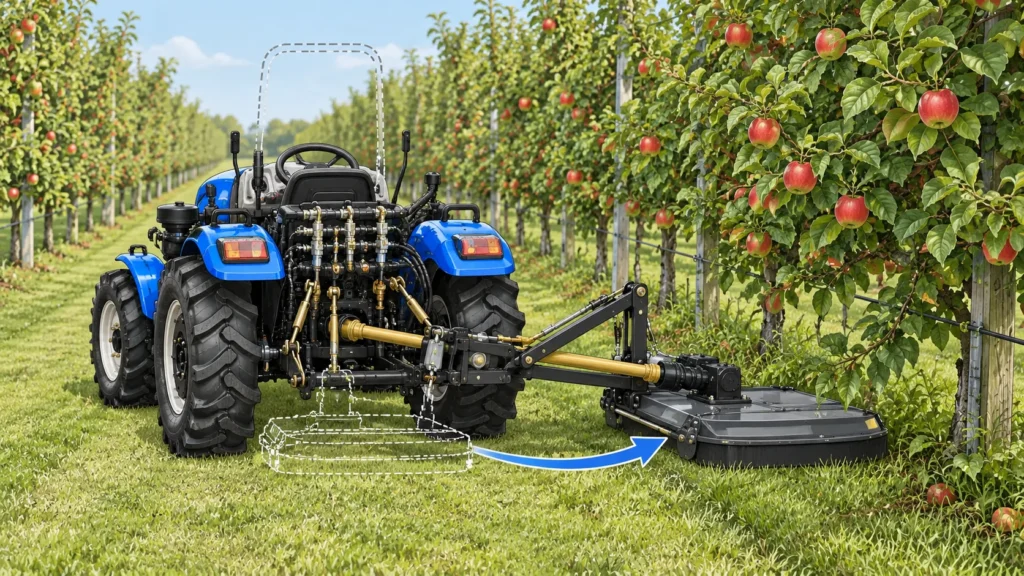
Choose cutting width to suit the alley and the area under the trees that must be reached. A twin-rotor PTO rotary mower is one mower type to compare; use the selected model’s own cutting width, PTO power requirement, input speed and weight to match the tractor. Check whether a quoted horsepower figure describes engine power or PTO output before comparing it with the tractor’s rating.
To reach under the drip line while keeping the tractor clear of low branches, compare offset or side-shift mowers. Use the mower’s connection diagram to match its offset and tilt controls, hydraulic flow and pressure to the tractor. Check PTO input speed, shaft connections and shaft length for the mounted combination.
Keep the tractor’s raised ROPS clear of branches while the mower reaches underneath. Trim low limbs along the travel line or choose a different route where necessary. Never cut or shorten the ROPS to make the tractor fit.
Moving Full Apple Bins: Trailer, Forks or a Separate Forklift
Start from the weight and dimensions of one full bin. UVM gives up to 800 lb (363 kg) for filled 12–20 bushel bins, but your bin size and fill determine the actual load. Weigh a loaded bin, then check how many fit on the trailer deck or fork attachment.
Bin trailer. A trailer carries the load on its axle, while the tractor must pull and stop the combination. For a farm tractor trailer, compare the bin-and-fruit weight with rated payload. Add the trailer’s empty weight for the towing and braking check, and confirm deck dimensions and an approved loading arrangement.
UF/IFAS Extension’s loading and towing guidance recommends brakes on towed equipment when its fully loaded weight exceeds 1.5 times the towing unit’s weight. For a 1,250 kg (2,756 lb) tractor, that comparison point is 1,875 kg (4,134 lb). The manufacturer’s towing limits, hitch rating and braking requirements also apply.
As an illustrative calculation, a 500 kg (1,102 lb) empty trailer carrying 1,800 kg (3,968 lb) of bins and fruit has a total towed weight of 2,300 kg (5,071 lb). Check the 1,800 kg cargo against the trailer’s rated payload and the 2,300 kg total against the tractor’s towing limits. That total exceeds the 1,875 kg comparison point above, so the UF/IFAS guidance calls for trailer brakes. Bin dimensions and deck layout determine how that cargo can be carried.
Forks. Compare the full bin and attachment weight with the tractor-and-fork combination’s capacity at the actual load position. A rear linkage or loader rating measured close to the tractor may not describe capacity farther out where the bin sits. Our narrow-row vineyard guide explains checking lift ratings at the actual load position. A front-loader pallet fork requires a compatible loader; check the loader’s capacity at the required reach and height, attachment compatibility and specified ballast.
Separate forklift. A dedicated forklift keeps yard and cooler work off the tractor. UVM identifies electric or propane forklifts for indoor use, where exhaust fumes are a concern; follow the equipment’s indoor-use and ventilation requirements.
A Washington L&I report on a 2024 cherry-orchard rollover describes an operator moving bins on three-point forks who turned near an embankment and slid in soft soil. The ROPS was folded and the seat belt unused. Turn on firm ground away from banks, travel with bins low, keep the ROPS raised and the belt fastened, and never stand under a raised load. Plan the bin route and loading area before the first harvest.
One Apple Orchard Tractor or Two: Matching the Plan to Your Orchard
Choose one tractor when the same working configuration fits the orchard and meets the sprayer, mower and bin-handling requirements. Choose separate machines when those jobs call for conflicting dimensions, protection or load capacity. UVM describes spraying, mowing and bucket-work roles, while noting that one tractor may cover more than one.
| Your working situation | Practical plan | What decides the choice |
|---|---|---|
| One frame fits all routes and meets each implement’s requirements | One tractor for spraying, mowing and transport | PTO output and speed, working clearance, hydraulic compatibility and loaded capacity |
| The spray job requires a cab or frame that cannot work close enough under the canopy | Separate spray and mowing tractors | Protected working height, mowing reach and the sprayer’s PTO requirement |
| Frequent bin handling needs a dedicated lifting setup | A compatible tractor-and-fork combination or a separate forklift | Capacity at the bin’s load position, lifting height and the loading route |
| A small block uses a self-powered sprayer and light transport | A tractor for PTO mowing, with a suitable UTV for the other jobs | Mower requirements and the UTV’s rated payload and towing capacity |
A smaller tank reduces the carried load, but the sprayer’s PTO requirement still decides whether the same tractor can spray and mow. If an existing tractor cannot maintain the sprayer’s required PTO speed under load, use it only with implements whose power requirements it meets.
Compare Rongfeng’s 50–120 HP narrow 4WD tractors for orchard and greenhouse work by the working dimensions and implement requirements above. For frequent lifting, also compare standard compact tractors and utility frames with the required attachment capacity, checking their working height and width against the orchard route.
When comparing quotes, keep the tire and wheel settings, cab or ROPS configuration, attachments and required ballast consistent. Include the maintenance and scheduling needs of a second machine in the decision.
Before you buy, get the tractor-and-implement match in writing:
- The tractor’s rated PTO output and the implement’s required PTO power and input speed.
- Overall working width with the selected tires, wheel-track setting and each attachment.
- Working height with the ROPS raised and any sunshade or cab fitted.
- Lift capacity at a stated load position, including attachment weight, axle limits and required ballast.
- Hydraulic controls, connections, flow and pressure matched to the implement; compatible PTO shaft connections and length.
- Turning space for the complete combination at row ends and along the bin route.
- Loaded implement or trailer weight, rated payload, hitch and towing limits, brakes, and permitted operation on your terrain.
FAQ
Can a UTV replace a tractor in a small apple orchard?
A UTV can handle transport and a self-powered sprayer when their fully loaded weights fit its payload and towing ratings. Most UTVs have no PTO, so a PTO mower or tractor-powered air-blast fan still requires a compatible tractor.
What if my rows are too narrow for any tractor?
Measure the clear passage rather than relying on planting spacing. Even before trees and posts are counted, a 1,200 mm (47 in) tractor centered between rows 5 ft (1.52 m) apart has only about 162 mm (6.4 in) on each side. If the mature passage cannot accommodate the tractor and implement with room to steer, use equipment such as walk-behind mowers, backpack or handgun sprayers, and suitable carts.
Do I need a cab to spray apples?
Check the label for the pesticide and application method you will use. Some air-blast applications require an enclosed cab, and any stated PPE and respirator requirements still govern; see WSU’s enclosed-cab guidance. Include the cab’s height when checking the orchard route.
What sets a tractor apart for orchard work?
Narrow overall width, clearance beneath the canopy with the ROPS raised, and room to turn with the implement attached. The tractor must also provide the PTO output, hydraulic compatibility and load capacity for the jobs it will do. Compare the complete working configuration with your orchard measurements.
Get Your Configuration Checked
Send Rongfeng Machine your mature orchard’s clear passage width, lowest overhead clearance, sprayer model and PTO requirement, full bin weight and handling method, and steepest slope. Include your country and intended attachments. The team can compare tire and wheel-spacing options and put the proposed tractor-and-implement configuration in writing. Single-unit orders are accepted, and dealers can submit their customers’ requirements. Request a configured quote or message Rongfeng on WhatsApp.