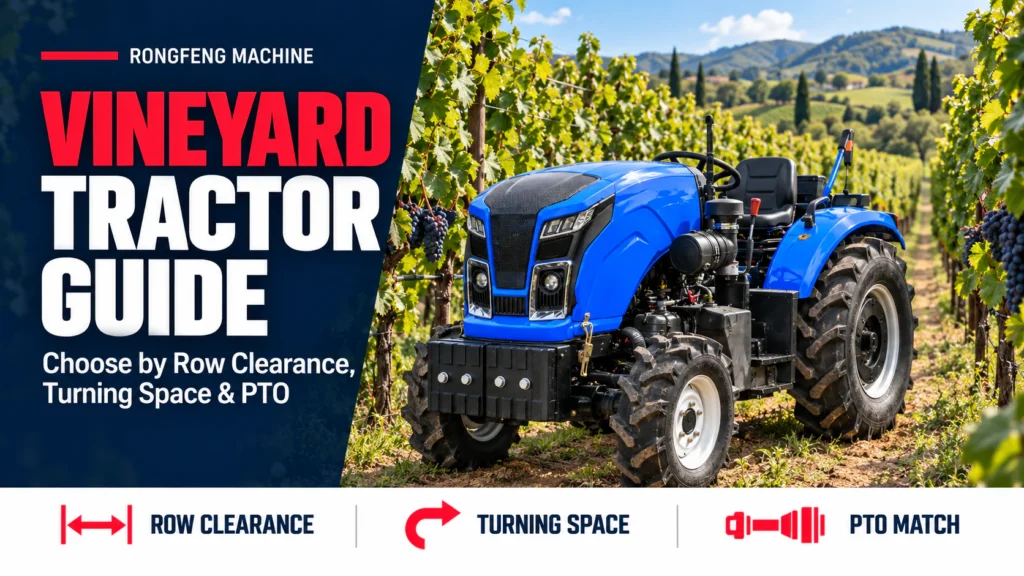
Vineyard tractors are designed or configured to work between vine canopies while powering sprayers, mowers and other implements. Narrow axles and bodywork help them pass down the row; steering geometry helps them turn at its end. Operator protection, wheel settings and implement capacity complete the design.
For a buyer, three checks come first: can the whole machine pass through the mature canopy, can it turn with the intended implement, and can it power and carry the season’s hardest job? A tractor’s width or engine horsepower alone cannot answer all three.
What makes a tractor suitable for narrow vine rows?
An in-row tractor has to keep its tires, fenders and upper body inside the working lane. Its main design features serve different purposes:
- Narrow axle and wheel configurations reduce the width over the tires. Slim fenders and tucked-in steps reduce protrusions that can catch vines.
- Wheelbase and steering geometry affect how much room the tractor needs at row ends. The implement’s length and mounting position also affect the turn.
- A low profile with suitable rollover protection helps the machine work around trellises. Hood height, operator clearance and the height of an upright roll bar or cab are separate measurements.
- Wheel settings, ballast and traction equipment help manage the load and ground conditions. Four-wheel drive improves traction; it does not prevent a narrow tractor from rolling over.
- PTO, hydraulics and hitch capacity determine which tools the tractor can operate, including when a sprayer or harvest bin is fully loaded.
Different layouts solve different clearance problems
| Tractor layout | How it works in the vineyard | What to check |
|---|---|---|
| In-row wheeled tractor | Travels in the aisle between canopy walls | Configured width, protected height and implement clearance |
| Crawler or half-track tractor | Uses tracks for traction and flotation | Track width, ground conditions and space for the turning maneuver |
| Articulated tractor | Steers by pivoting the chassis | The path of both chassis sections and the attached implement |
| Over-the-row tractor | Straddles the vine row | Trellis height, row width and compatibility with the training system |
There is no row-spacing cutoff that selects one layout for every vineyard. A narrow wheeled tractor may fit an aisle that a wider articulated machine cannot. Compare the complete working configuration with the space in your blocks.
Vineyard, orchard or compact utility tractor?
Vineyard selection usually starts with the aisle between canopy walls; orchard selection also has to account for overhanging branches. Both applications can require a narrow, low machine. Model names are a starting point, so compare actual dimensions, operator protection and implement capacity.
A compact utility tractor can work in a vineyard if it clears the mature canopy, turns within the headland and meets the implement requirements. Compact size does not by itself establish hydraulic capacity, PTO output or suitability for slopes.
How narrow should the tractor be for your row spacing?
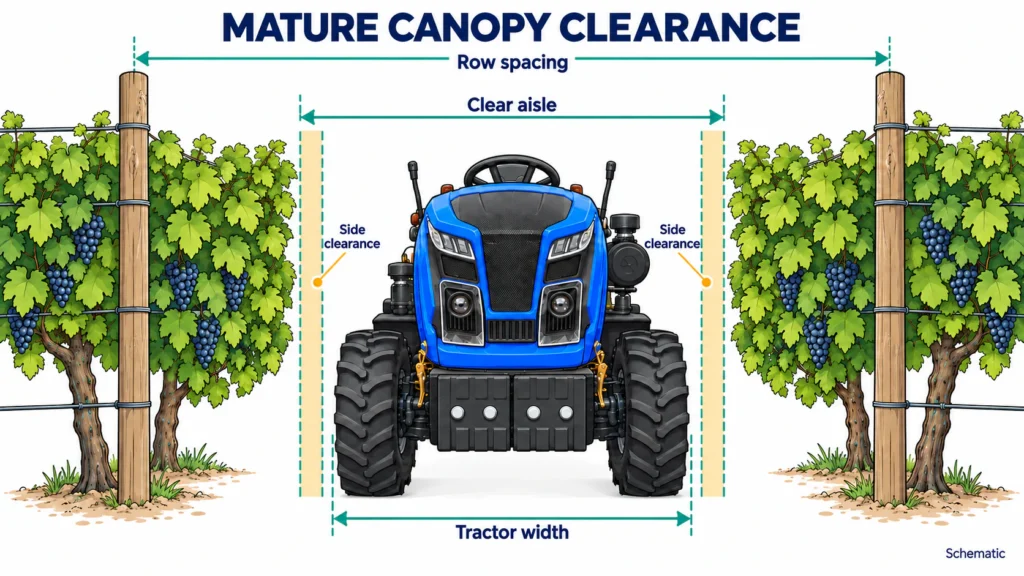
Use the clear aisle at full canopy to judge fit. Row spacing is measured between row centers, but shoots, leaves, posts and irrigation equipment can occupy part of that space.
Montana State University’s vineyard row-planning guide recommends measuring the equipment and allowing another 1–2 ft (about 300–600 mm) of buffer between rows on slopes to account for drift. The available margin must accommodate steering corrections and uneven ground as well as the machine’s stationary width.
Read the width measurement correctly
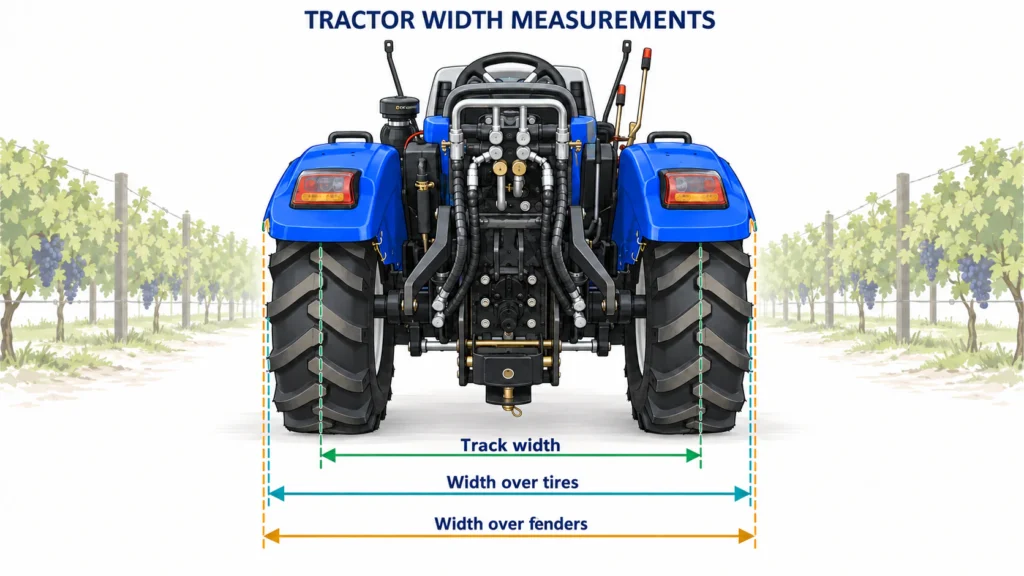
Overall width should describe the widest part of the configured tractor. The tires may set that width, or the fenders, steps or mirrors may extend farther.
Track width is the distance between wheel centers. It is not the width over the tires. Changing tires or approved wheel settings can change the tractor’s outside width, so confirm the dimensions of the configuration being quoted.
Check upper clearance separately. A tractor can clear the vines at tire height while its mirrors, cab or roll bar reach the canopy higher up.
Measure the lane and calculate the side margin
- Measure the narrowest mature-canopy aisle at tire, fender and upper-body height. Include posts, leaning vines and other fixed obstructions.
- Measure the widest point of the tractor and implement in their intended working positions.
- For a centered machine with equal clearance on both sides, calculate: side margin = (clear aisle width − machine width) ÷ 2.
- Check the route into and out of that row, including row ends and changes in ground level. Arrange a demonstration with the intended implement where practical.
For a side-mounted or offset tool, check its working side separately; halving the remaining space will not describe its clearance. A positive result means the machine fits within the measured stationary space. It still needs room for canopy movement, steering and the movement of the implement.
Worked example: 1,200–1,300 mm tractors in 6–10 ft rows
Rongfeng’s greenhouse tractor specifications list an overall width of 1,200 mm (47.2 in) for the RF-504 and RF-604, and 1,300 mm (51.2 in) for the RF-704, RF-804, RF-1004 and RF-1204. Using those widths, the space on each side before accounting for canopy intrusion is:
| Row spacing | 1,200 mm tractor | 1,300 mm tractor |
|---|---|---|
| 6 ft (1.83 m) | 314 mm (12.4 in) | 264 mm (10.4 in) |
| 7 ft (2.13 m) | 467 mm (18.4 in) | 417 mm (16.4 in) |
| 8 ft (2.44 m) | 619 mm (24.4 in) | 569 mm (22.4 in) |
| 10 ft (3.05 m) | 924 mm (36.4 in) | 874 mm (34.4 in) |
Suppose rows are spaced 7 ft apart and each neighboring canopy extends 12 in into the aisle. The clear lane becomes 84 − 12 − 12 = 60 in (1,524 mm). That leaves approximately 162 mm (6.4 in) per side for a 1,200 mm tractor, or 112 mm (4.4 in) for a 1,300 mm tractor, before allowing for movement. This is why a tractor that clears bare trellis posts can become a tight fit later in the season.
The RF-504 50 HP narrow 4WD tractor provides a concrete specification example:
| Published RF-504 specification | Value |
|---|---|
| Overall width | 1,200 mm |
| Wheelbase | 1,550 mm |
| Front / rear tire size | 600-12 / 9.50-16 |
| Listed weight | 1,250 kg |
| Rear PTO speeds | 540 / 720 rpm |
Confirm the width with the selected tires and wheel settings. Use the implement’s outside width if it exceeds the tractor’s.
Trellis layout and tools can require a wider aisle
Single-curtain systems such as VSP keep one canopy wall along each row; divided systems such as Geneva Double Curtain occupy more space. For new vineyard planning, Montana State’s guide recommends at least 10 ft (3.0 m) between single-curtain rows and 12 ft (3.7 m) between double-curtain trellises.
For an existing block, measure its actual clear lane. Also distinguish an implement’s cutting or spraying width from its physical outside width. A mower can cut a 1 m strip while its frame occupies more space.
Which specifications matter for the season’s jobs?
Choose capacity around the implements you will use. A hydraulic under-vine tool, a PTO-driven sprayer and a harvest-bin lift place different demands on the same tractor.
| Job | Typical drive or load | Specifications to match |
|---|---|---|
| Shredding prunings | Rear PTO | Required PTO power, speed and implement weight |
| Under-vine weeding | Hydraulic motor or cylinders, depending on the tool | Flow, working pressure, remote valves and return circuit |
| Mowing | PTO-driven mower | PTO power and speed, outside width, hitch and lift requirements |
| Air-blast spraying | PTO-driven pump and fan | PTO power and speed, fully loaded weight and ballast |
| Hedging or leaf removal | Hydraulic drive, depending on the equipment | Continuous flow, pressure, mounting position and load |
| Harvest-bin transport | Trailer, three-point forks or loader | Towing and braking limits, or lift rating at the actual load position |
Spraying: match PTO output and the full load
Engine horsepower describes engine output. PTO horsepower describes the power available to drive the implement. For example, New Holland lists its T4.80V vineyard tractor at 74 gross engine HP and 65 PTO HP. Use a model’s stated PTO rating when comparing it with a sprayer requirement.
Match both power and shaft speed. A 540 rpm sprayer needs the tractor’s 540 rpm PTO setting; selecting 720 rpm is not a way to compensate for insufficient power. Confirm the PTO shaft connection and driveline requirements as well.
For a tractor-mounted air-blast sprayer, calculate the mounted load with the tank full, including the sprayer frame and liquid. Weight behind the rear axle can unload the front wheels. Check the tractor’s hitch, axle and tire limits, and use the ballast specified for that tractor and implement combination.
A trailed sprayer shifts the check toward drawbar load, total towing weight, traction and braking. Tank volume alone does not establish the power requirement: the pump and fan also have to match the tractor.
Mowing: check more than PTO speed
Rongfeng’s tractor implements catalog lists the 9GX-1.5 rotary mower with a 1,500 mm cutting width, 335 kg weight, 540 rpm PTO input and a 40–60 HP tractor-power range, mounted on a three-point hitch.
Its cutting width already exceeds the RF-504’s 1,200 mm tractor width, so the mower becomes part of the row-fit decision. Use its full outside dimensions to check clearance. The RF-504 offers a 540 rpm PTO setting, but speed is one part of the match: also check the power requirement, hitch category, driveline dimensions and lift capacity at the mounted load position. Establish whether a horsepower requirement refers to engine or PTO output before comparing ratings.
Apply the same checks to a twin-rotor PTO mower. Compare its own specifications with the tractor; different mower designs can have different power, mounting and clearance requirements.
Under-vine tools: match hydraulic flow and connections
For a hydraulically driven tool, get its required flow range in L/min or gpm, working pressure and whether it needs continuous flow. Match those requirements to the flow available at the tractor’s remote valves while operating the tool. Total pump output alone may not describe what the implement receives.
Count the required double-acting valves and check any return-line requirements. A tool that uses a cylinder briefly to shift position has a different hydraulic demand from a motor running continuously. Supply flow within the implement maker’s specified range; more flow is not automatically better.
Confirm the mounting position too. A side-mounted tool needs space beside the tractor, and a mower requiring a mid-PTO needs that specific PTO provision.
Harvest: compare lift ratings at the load position
For a farm tractor trailer, check total loaded weight, drawbar load and the tractor-trailer braking arrangement.
For a lifted bin, include the bin, fruit and forks or other attachment in the load. Three-point capacity at the lower-link ends is different from capacity farther behind them. Loader capacity at the pivot pins is different from capacity at the bin’s center of gravity and required height.
Weigh a representative full bin and compare the combined load with a rating at the intended reach. Check axle and tire limits and the required ballast. Keep carried loads low during travel, within the operating instructions for the attachment.
How much turning room does the tractor need?
Wheelbase is one part of turning geometry. The RF-504’s published 1,550 mm wheelbase describes axle spacing; steering angle and the rest of the configuration determine how it turns. It cannot be converted directly into a turning radius.
When comparing turning specifications, establish:
- Whether the figure is a radius or diameter; diameter is twice the radius.
- Whether it describes the tire path or the tractor’s outside clearance.
- Whether the measurement uses steering brakes, and which tire and drive configuration was tested.
ISO 789-3:2015 provides a test method for the turning and clearance diameters of wheeled agricultural tractors. Compare figures measured on the same basis.
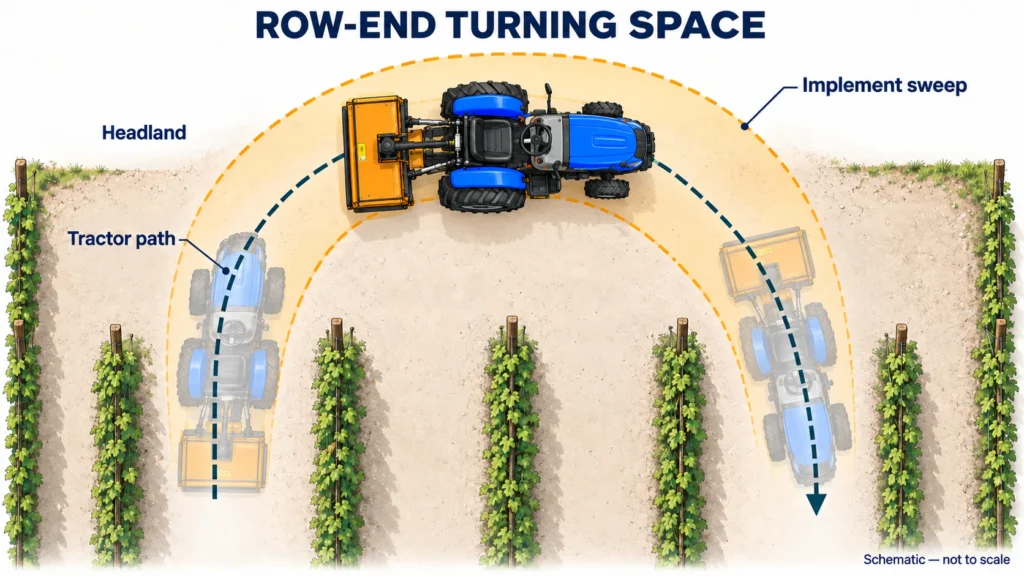
The tractor’s turning figure is only the first check for a headland. A mounted mower can swing outward, and a trailed sprayer follows a different path. Check the whole combination against end posts, anchors, fences and ditches. Where a direct turn into the next row is too tight, plan a wider route through alternate rows or provide more headland space.
What changes on slopes and soft ground?
A narrow wheel track reduces lateral stability for a given center-of-gravity height. Raised implements and loads change that center of gravity, so a tractor that fits the row still needs a suitable operating configuration for the terrain.
Use the widest wheel setting approved for the tractor that also clears the vineyard. Follow the model’s ballast and load instructions, and keep carried loads low. Plan turns and travel routes around slope direction, uneven ground and row-end hazards. Four-wheel drive can improve grip, but grip does not establish rollover safety.
Check slope guidance in the operating manual for the exact tractor and configuration. Evaluate the work with the sprayer full or the bin loaded. Do not transfer a slope limit from a different tractor model or treat a tractor’s road-speed rating as a slope rating.
On soft ground, tire or track selection also affects flotation, rutting and steering. Compare the complete machine’s weight, contact area and turning behavior under the conditions in the block. Tracks still require adequate row and headland clearance.
How should you check height, ROPS and cab protection?
Measure the lowest obstruction along the route and the highest point of the working tractor. Include the upright roll-over protective structure (ROPS), cab, mirrors and any equipment on top. A dimension taken to the hood or seat does not establish overhead clearance for the operator.
Choose a configuration that can work under the trellis with its required protection in place. A folded roll bar provides no rollover protection. Keep a foldable ROPS raised and locked, and use the seat belt within that protected configuration as directed by the operator’s manual.
A 2019 Washington State fatality report describes a narrow tractor with an attached sprayer that rolled over after leaving a road. Its ROPS was folded down and it had no seat belt. Low-clearance work must also account for the journey between blocks.
For spraying, distinguish weather protection from pesticide protection. Air conditioning alone does not establish that a cab is suitable for the chemicals being applied. Check the pesticide label and the cab’s specified protection and filtration. Washington State University’s enclosed-cab guidance explains that the label still governs respirator use, and that the applicator must wear the required PPE when leaving the cab and contacting treated surfaces.
What should be confirmed before ordering?
Build the specification around your narrowest mature-canopy lane, headland layout and main implements. Ask for the figures for the configuration you intend to buy.
| Confirm | Match it against |
|---|---|
| Outside width with the selected tires and wheel settings | Clear lane at tire, fender and upper-body height |
| Height with upright ROPS or cab | Lowest trellis wire and other overhead obstructions |
| Turning dimensions and measurement basis | Headland space with the implement attached |
| Rated PTO power, shaft speeds and connection | Sprayer, mower and shredder requirements |
| Hydraulic flow at remotes, pressure and valve count | Each tool’s operating requirements |
| Hitch category and lift capacity at a stated load position | Implement or bin weight, including attachments |
| Axle, tire, ballast and towing limits | Fully loaded sprayer, bin or trailer |
| Working speeds at the required PTO engine speed | Spraying and other slow, steady-speed jobs |
| Parts identification and wear-part availability | Maintenance and repairs during the season |
For slow work, compare the available ground speeds at the engine speed needed to run the PTO correctly. Gear count and maximum road speed do not show whether the tractor can hold the required spraying pace. Confirm creeper gearing if the task requires it.
When comparing Rongfeng’s 50–120 HP narrow 4WD tractors, send your mature-canopy lane width, lowest overhead clearance, headland dimensions, terrain and implement models. Request a quote with the selected tires, wheel settings, transmission and operator protection specified, so the quoted machine can be checked against the work it needs to do.
FAQ
Can a regular compact tractor work in a vineyard?
Yes, if the whole tractor-and-implement combination clears the mature canopy, turns within the headland and meets the load and power requirements. Measure the actual configuration rather than relying on the word “compact.”
Can a narrow tractor work in 6 ft vine rows?
It depends on the clear aisle. A 1,200 mm tractor centered between rows 6 ft apart has 314 mm of space per side before accounting for canopy intrusion. Subtract the space occupied by the vines and check the implement, upper body and turning route before deciding.
How much horsepower does a vineyard tractor need?
Start with the power requirements of your sprayer, mower and other driven implements. Match a PTO power requirement to rated PTO output, and also check PTO speed, hydraulic capacity and the loaded implement’s weight. A higher engine horsepower figure does not resolve a width or lift limitation.
What is the difference between vineyard and orchard tractors?
Vineyard work emphasizes clearance between canopy walls; orchard work also involves overhead branches. The requirements overlap. Compare configured width, protected height, turning room and implement capacity rather than assuming the model label guarantees a fit.
Does a vineyard tractor need a cab?
A cab can improve comfort and weather protection. For pesticide application, the product label and the cab’s specified protective capability determine what is suitable and which PPE remains necessary. Include cab height in the row-fit check.