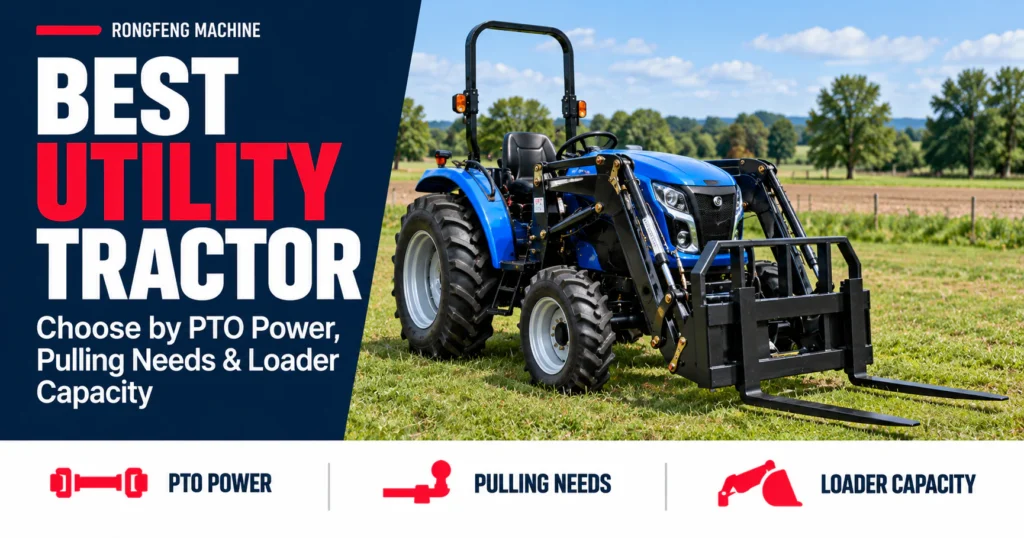
Choose the best utility tractor by matching PTO power, pulling requirements and loader capacity to your regular jobs, then checking implement fit and service support. Dealers and importers should use the customer’s job list and destination market.
Which job should set the size of your utility tractor?
Start with your heaviest regular job, then check acreage and available working time. ASAE D497.7 covers typical implement power requirements. The implement, its width and your ground set the initial requirement; acreage and seasonal work windows determine how much work must be finished. Annual hours affect the value of durability and comfort.
| Job | Implement and width | PTO, draft or loader | Hours per year | Ground |
|---|---|---|---|---|
| Bale hay | Round baler | PTO | ___ | Slopes |
| Clear brush | Rotary cutter | PTO | ___ | Heavy cover |
| Move bales or pallets | Loader, fork or grapple | Loader | ___ | Mud, yard |
| Grade the driveway | Box blade | Draft | ___ | Gravel |
List your regular PTO, draft and loader jobs with their implements, width, ground conditions and annual hours. Separate occasional jobs that could be hired out from work the purchased tractor must handle.
Narrow orchard or vineyard rows need a specialty tractor (choosing an orchard tractor covers that), and mowing-only properties usually fit a lighter class.
How much PTO horsepower and weight does that job need?
Your PTO-power target is the implement maker’s stated requirement for the working width, plus any margin it recommends for heavy soil, slopes or thick cover.
Engine horsepower vs PTO horsepower: which number to size with
Engine power is measured at the engine; PTO power is what reaches the shaft after drivetrain losses. If a sheet shows only engine power, ask for PTO power at rated PTO speed, with engine speed and the test basis stated. A figure calculated from engine power is only an estimate.
Reading a tractor spec sheet
Rongfeng Machine, the publisher of this guide, lists the following specifications for three of its utility tractors from 50 to 140 HP:
| Field, as listed | RF-804 | RF-904 | RF-1004 |
|---|---|---|---|
| Engine | Weifang 490, turbocharged | Weifang 4102, naturally aspirated | Weifang 4102, turbocharged |
| Engine power | 58.8 kW (“80 HP”) | 66.2 kW (“90 HP”) | 73.6 kW (“100 HP”) |
| Drive / gears | 4WD / 8F+8R | 4WD / 8F+8R | 4WD / 8F+8R |
| PTO speeds | 540/760 rpm | 540/760 rpm | 540/760 rpm |
| Machine weight | 1,500 kg (about 3,310 lb) | 1,700 kg (about 3,750 lb) | 1,800 kg (about 3,970 lb) |
| Tires, front / rear | 7.5-16 / 11.2-28 | 7.5-16 / 11.2-28 | 8.3-20 / 12.4-28 |
The RF-1004 lists more engine power and weight than the RF-804, but this table gives no PTO power, rear lift, hydraulic flow or loader rating. Obtain those figures and confirm the ordered configuration before choosing a model. U.S. emission certification for these configurations has not been verified.
Weight, ballast and stance
Weight and correct ballast help turn power into pull. For draft work, check the implement maker’s tractor recommendation, working width and depth, and intended gear speed; PTO power or loader capacity alone cannot size a pulling job. Compare wheel track, clearance and turning space with your ground and gates. Front-wheel assist adds traction, but extra weight can rut a soft yard. The US Environmental Protection Agency’s septic guidance says not to drive on a drainfield because heavy equipment compacts soil and can damage pipes. Ask what machine weight includes and which tires and ballast the maker approves.
Will your implements fit? Hitch, lift, hydraulics, PTO speed
Implement fit comes down to four checks against every implement you own or plan to buy, including new tractor implements and attachments. Run them before you compare prices.
Three-point hitch category and rear lift capacity
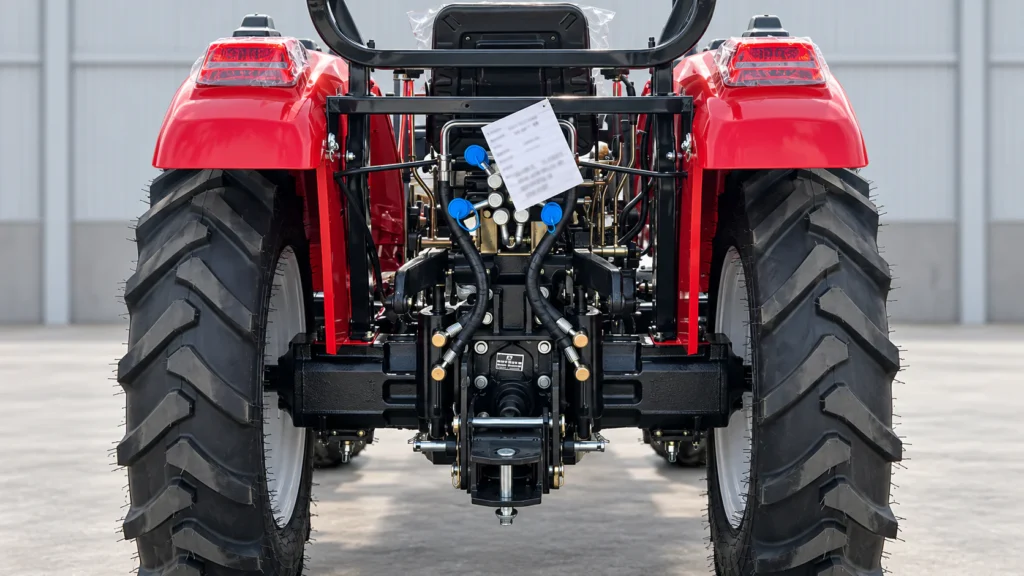
Hitch category sets pin size and lower-link spacing, and it must match the implement’s. Bushings may adapt a compatible smaller implement, but do not establish suitability for the job. If you swap tools often, check quick-hitch fit and which implements the dealer can supply. Rear lift is quoted at a stated point, such as the link ends or farther behind them. Compare ratings at the same point and confirm the implement’s weight and center-of-gravity position with the maker.
Remote valves and hydraulic flow
Count the hydraulic functions you’ll run against the tractor’s remote valves (SCVs). Pump flow can include oil that goes to steering, so compare the flow delivered at the remote couplers, in L/min (gpm), with the implement maker’s requirement.
PTO speeds your implements expect
PTO shafts turn at 540 rpm or 1,000 rpm at full recommended speed, according to Penn State Extension. Run each implement only at its rated speed: a 540 rpm implement on the 1,000 rpm setting turns at about 1.85 times its rated speed. If a tractor lists a second speed such as 760 rpm, ask in writing what it’s for and whether the implement maker allows it. Keep the PTO shield and driveline guards on and disengage the PTO and shut off the tractor before you dismount to unclog a machine.
Before you sign: run a hitch test
At the seller’s yard, have a qualified dealer check your actual implement or its manual against the tractor’s written PTO, hitch and lift figures:
- Match the implement’s PTO speed and power range to the tractor’s.
- Match hitch category, pin size and any approved adapters.
- Confirm rear lift for the implement’s weight and center-of-gravity position.
- With the PTO disengaged, check hitch travel, clearance and driveline length according to both manuals.
A successful lift alone does not prove suitability. Resolve interference, driveline bottoming or separation, and missing ratings before operating. Keep people clear; any powered trial must follow the manuals with guards fitted.
Loader work: lift ratings, matching and stability
A loader rating only means something at its stated rating point and with the tractor ballasted as its manual says.
Read the loader rating at the right point
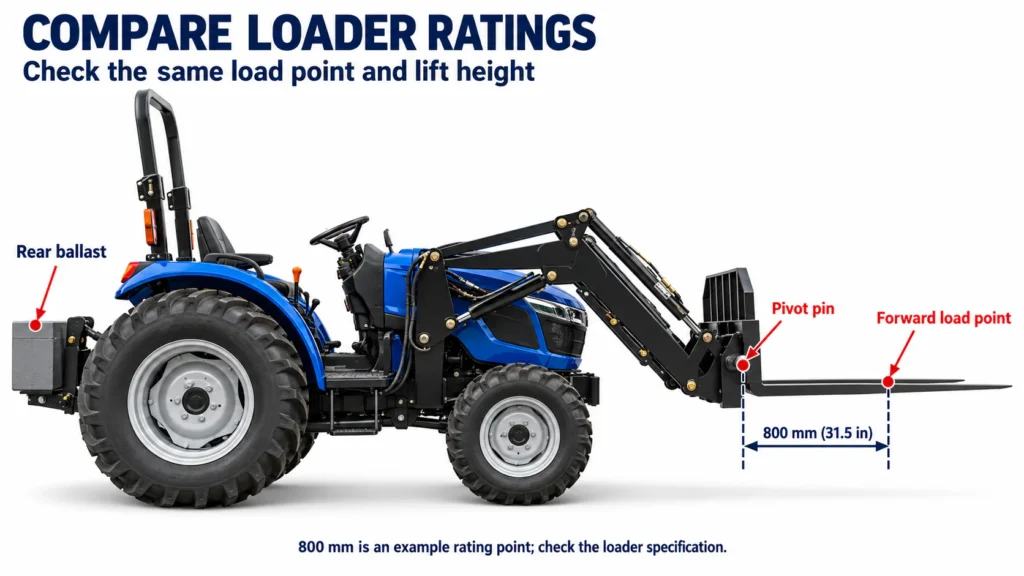
Compare loader ratings at the same load point and lift height. The Massey Ferguson FL.3522 loader is rated at 2,000 kg (4,410 lb) to full height at the pivot pins but 1,250 kg (2,760 lb) to full height 800 mm (31.5 in) forward of them, nearer where a load sits, according to AGCO’s loader spec sheet. The self-leveling FL.3615 on the same sheet runs the other way: 1,370 kg (3,020 lb) at the pins and 1,550 kg (3,420 lb) forward. Compare the same rating point and lift height on each candidate.
Loader matched to the tractor, plus counterweight
A loader’s rating describes the loader, not the tractor, and the same sheet notes that specifications may vary with tractor model, tires and hydraulic options. Ask the tractor maker which loaders it approves and what its front-axle and tire limits are; a compact-size loader can leave a utility tractor’s capacity unused. For a front loader pallet fork, bucket or grapple, ask the loader maker how the attachment’s weight counts against the rating. The sheet also states that tractors must be properly ballasted for loader operation, per the operator’s manual, so fit the specified rear ballast before lifting and carry loads low on slopes.
Under OSHA’s 29 CFR 1928.51, employers must provide a ROPS (rollover protective structure) and a seat belt on each agricultural tractor over 20 engine horsepower (about 15 kW) built after October 25, 1976 that an employee operates, apart from listed exempted uses such as low-profile tractors in orchards, vineyards or hop yards where a ROPS would substantially interfere with the work. Each ROPS must carry a label naming the tractors it fits, so look for it, keep a foldable ROPS up and wear the belt.
Cab and transmission: what’s worth paying for?
Pick the transmission for your most frequent job, and pay for an enclosed cab when hours, climate or dust justify it:
- Loader cycles all day: compare the controls on the actual candidates. A power shuttle changes direction with a lever; a hydrostatic transmission (HST) uses pedals and is not offered on every utility model. Try both where available, then choose the controls and low-speed range that suit the operator and job.
- Long PTO or draft passes: a gear transmission holds a set ground speed; check the speed chart for more than one gear in your implement’s working speed.
- Cab: worth it for long hours, heat, cold or dust, but it adds height and systems to maintain. Check its height against your lowest door and ask whether the cab frame is the ROPS; for short hours in mild weather, an open station with a ROPS is the plainer choice.
Dealer, parts and warranty: what should you settle before you sign?
- Service: ask the nearest dealer, before buying elsewhere, whether it does warranty work on tractors it didn’t sell, and how soon.
- Parts: local wear parts, major-part lead times, how long the brand has supported tractors in your area, and the engine’s make and model. An engine maker with its own network near you may give you a second parts route.
For a lower-priced candidate, request the engine test and inspection reports offered with the quote. Check that each identifies the configuration, test conditions and issuer.
How do you choose the best utility tractor for the money?
Compare quotes for the same usable package: tractor, required implements, loader attachment, ballast, cab options, freight, duties and setup. Then compare wear-part availability and repair labor and transport costs.
For an imported line, include parts stocking, technician access and warranty reimbursement in the ownership budget. Ask the seller to itemize any unquoted charges.
Warranty fine print to get in writing
Get the warranty document and model-specific maintenance schedule. Check term and start date, parts and labor coverage, travel and transport charges, who may repair the machine, and any first-service condition. Write down who pays excluded costs. Before shipment, agree which manuals, warranty documents, parts lists and inspection or test reports will accompany the delivered configuration.
Buying away from a local dealer, or importing a line
Agree who handles customs, duties, assembly and setup. Under 40 CFR 1068.101(b)(5), uncertified imported engines and equipment, including used ones, are generally treated as new; the rule also describes exceptions. Confirm destination-market emission documents, PTO and hitch compatibility, and road-use requirements before ordering. Dealers and importers choosing a line should put warranty labor and freight reimbursement, parts stocking, technician training and diagnostic access in the agreement.
Tier 4 emissions and electronics: what should a US buyer check?
The EPA emission label
For a new nonroad diesel tractor intended for the US, 40 CFR 1039.135 requires a certified engine to carry an “EMISSION CONTROL INFORMATION” label identifying its EPA engine family, power category and model-year compliance. 40 CFR 1068.101(a)(1) generally requires both a valid certificate of conformity and the required label for sale or import, subject to applicable exemptions. Request a label photo and matching certificate information. A certificate does not replace a missing required label; resolve any claimed exemption or mismatch before ordering.
A CE mark does not establish US EPA emission compliance; the European Commission explains its European Economic Area scope.
Tier 4 upkeep and diagnostics
DieselNet describes urea SCR (selective catalytic reduction) for NOx control and engines with or without diesel particulate filters (DPF). Depending on the engine, upkeep may involve diesel exhaust fluid (DEF), filter regeneration or both. Under 40 CFR 1068.101(b)(1), operating an engine without appropriate urea when its controls rely on it is a form of tampering. Ask which systems the actual engine uses, their service intervals and how the service provider handles its fault codes.
A side-by-side checklist for comparing utility tractors
Fill this checklist from written specifications and quote terms for each candidate.
The comparison table
| What to write down | Ask for, in writing | Tractor A | Tractor B |
|---|---|---|---|
| 1. Size-setting job | Heaviest PTO, draft and loader jobs; annual hours | ||
| 2. PTO power | At rated PTO speed; engine speed and test basis | ||
| 3. Weight, ballast | What the weight includes; ballast weights | ||
| 4. Clearance, stance | Ground clearance; wheel track; turning radius | ||
| 5. Hitch category | Matches your implements | ||
| 6. Rear lift | Figure plus measuring point | ||
| 7. Remotes, flow | Count; flow at couplers, L/min (gpm) | ||
| 8. PTO speeds | 540 / 1,000 rpm; purpose of any other speed | ||
| 9. Loader rating | At the pins and the maker’s forward point, full height; axle and tire limits | ||
| 10. Transmission | Type; speed chart | ||
| 11. Operator station | ROPS label; cab height vs doors | ||
| 12. Service | Nearest warranty shop; reads fault codes? | ||
| 13. Parts | Local wear parts; major-part lead time; engine make and model | ||
| 14. Warranty | Term; who pays parts, labor, travel and transport; service conditions | ||
| 15. EPA documents (new diesel, US) | Required label; matching certificate or documented exemption | ||
| 16. Draft work | Implement recommendation; width/depth; working speed; approved tires and ballast |
Which setup fits your work: decision rules
- Size to PTO power if your heaviest PTO job needs more than a candidate supplies: confirm measured PTO power meets the implement maker’s requirement and any margin it recommends, together with the correct PTO speed.
- Size to pulling requirements if your heaviest draft job exceeds the candidate’s confirmed implement recommendation: check working width, depth, gear speed, tires and approved ballast. Adequate PTO power or loader lift does not settle this branch.
- Size to loader capacity if your regular load exceeds the candidate’s rating: compare required lift height and load position, accounting for attachment weight and the tractor maker’s axle, tire and ballast limits.
- More than one heavy job: meet every applicable requirement in one configuration.
- Go lighter, or consider compact tractors, if all three job checks and implement-fit checks are satisfied by the lighter candidate. Missing data does not count as a pass.
- Support and market check: confirm written cost responsibilities, an acceptable repair and diagnostic path, and destination-market documents. Resolve gaps before committing.
Example: plowing or grading
If PTO and loader demands are light but the plow or box blade exceeds the lighter candidate’s confirmed capabilities, follow the draft branch. Check the implement recommendation, working speed, tires and ballast before choosing.
Quick answers: the best farm tractor, one tractor for every job, and reliability
What’s the best farm tractor to buy?
No single model is the best farm tractor for every farm. For yours or your customer’s, it is the one that meets the regular PTO, pulling and loader jobs, fits the implements and has an acceptable local service path.
Can one tractor do every job on your farm?
Rarely well. The weight that steadies a loader in the woods can rut a soft lawn and shouldn’t cross a septic drainfield, while a yard-weight tractor may struggle with a baler. Removable ballast narrows the gap; otherwise size to the heavy work or keep a lighter yard machine.
What is the most reliable tractor?
Compare model-specific maintenance requirements, wear-part availability and local repair support. For used tractors, inspect service records. Warranty terms identify who pays for repairs; they do not demonstrate how often a tractor will break down.
Comparing utility tractors from 50 to 140 HP? Request a utility tractor quote from Rongfeng Machine with your destination country, job list and planned implements. Ask for model-specific PTO and lift figures, matched loader options, parts lead times, warranty terms and emission documents for the proposed configuration.
Reference Sources
DieselNet, USA: Nonroad Diesel Engines — nonroad diesel emission standards and aftertreatment approaches.
ASAE D497.7 MAR2011 (R2015), ANSI preview — agricultural machinery management data and typical implement power requirements.
eCFR, 40 CFR 1039.135 — nonroad diesel engine label contents.
eCFR, 40 CFR 1068.101 — certification and label requirements, import treatment and prohibited tampering.
OSHA, 29 CFR 1928.51 — agricultural tractor ROPS, seat belts, labels and listed exemptions.
Penn State Extension, Power Take-Off (PTO) Safety — PTO speeds, guarding and shutdown practices.
US EPA, How to Care for Your Septic System — keep vehicles and heavy equipment off drainfields.
AGCO, Massey Ferguson FL.3522 / FL.3615 loader sheet — August 2025 ratings at specified points and heights, plus ballast requirements.
European Commission, CE marking — the meaning and scope of CE marking.